Showing posts with label Flies. Show all posts

Tuesday, 23 April 2024

Spring Butterflies Emerge

 Lepidopterists are always eager to see their first butterflies of the year and the very early species to appear are those that have hibernated as adults. However, by late March the true harbingers of Spring start to emerge from their chrysalises.


Orange-tip (Anthocharis cardamines) (male)


Small White (Pieris rapae) (female)


Large White (Pieris brassicae) (male)


Green Hairstreak (Callophrys rubi)


Holly Blue (Celastrina argiolus) (female)


Speckled Wood (Pararge aegeria) (male)


Phasia hemiptera (mating)

This is a parasitic tachinid fly and as its specific name suggests, it preys on bugs, mainly Green and Red-legged Shieldbugs. This species is sexually dimorphic and the male has rather attractive wings with metallic blue flashes.


Sunday, 14 May 2023

A Walk in the Garden

 Having undergone knee surgery in recent weeks, my ability to get out into the countryside, to look for emerging Spring butterflies, has been put on pause. 

My walking rehabilitation has been restricted to patrolling my garden for insects.


Orange-tip (Anthocharis cardamines) (male)


Speckled Wood (Pararge aegeria) (female)


Large Red Damselfly (Pyrrhosoma nymphula) (male)


Red Mason Bee (Osmia bicornis) (male)


Yellow Dungfly (Scathophaga stercoraria)


Hoverfly sp. (Helophilus pendulus)


Dock Bug (Coreus marginatus) (mating)


Hairy Shieldbug (Dolycoris baccarum)


Weevil sp. (Liophloeus tessulatus)


Crab Spider sp. (Xysticus cristatus) (female)


Friday, 14 May 2021

Some Butterflies and Moths in May

Pretty much all of our spring emerging butterfly species are now on the wing and I have been catching up with a few of them.

 The Painted Lady (Vanessa cardui) has also been on the wing this week. Last weekend, I saw at least a dozen flying around one of my local woods, a clear indication that a significant migration from the near continent has occurred. If weather conditions are good for breeding over the next few weeks then we may expect to see them everywhere during July and August. 

Conditions for moth-trapping are still marginal and catches have continued to disappoint. The following images of moths have been from daytime finds.


Pearl-bordered Fritillary (Boloria euphrosyne) (male)


Grizzled Skipper (Pyrgus malvae) (male)


Holly Blue (Celastrina argiolus) (male)


Orange-tip (Anthocharis cardamines) (female)


Painted Lady (Vanessa cardui)


Angle Shades (Phlogophora meticulosa)


Muslin Moth (Diaphora mendica) (female)


Nematopogon swammerdamella (Longhorn sp.)


Pyrausta aurata


Dark-edged Beefly (Bombylius major) (mating)


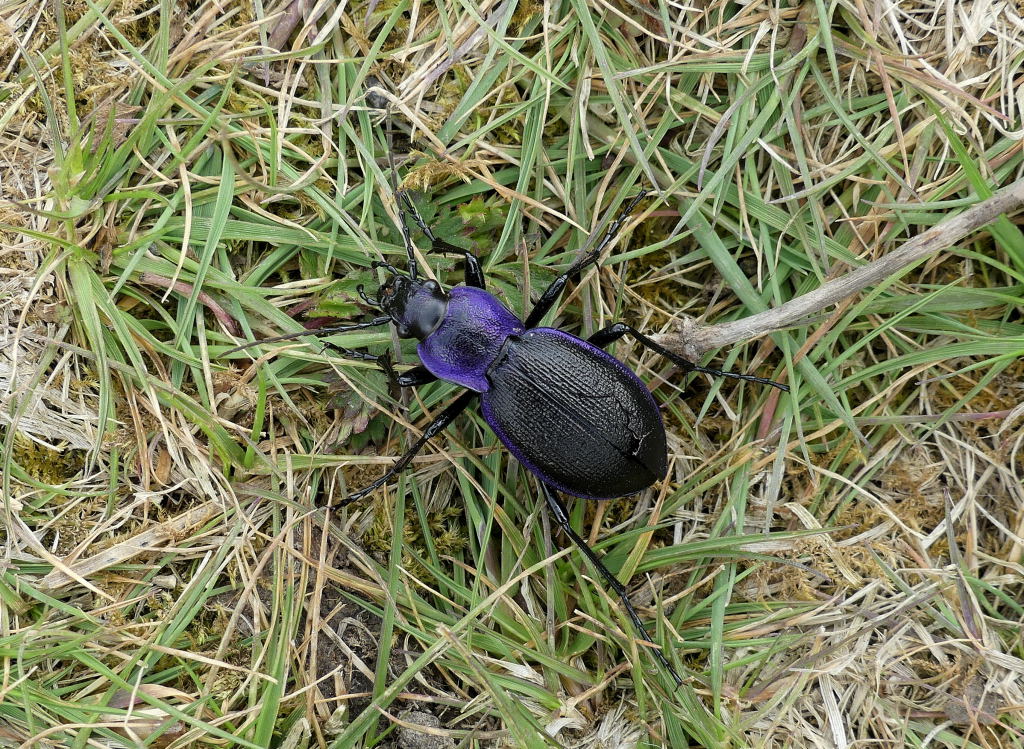
Carabus problematicus (Violet Ground Beetle sp.) (with damaged wing case)


Wednesday, 11 September 2019

Late Summer on Pevensey Levels

Although the evenings are drawing in and an autumnal chill can be felt as the sun goes down, there is still plenty to be seen out in the field.

 The expected emergence of a British brood of Long-tailed Blue (Lampides boeticus) in southern England is likely to be on the wing from the last week of September.

 On Pevensey Levels, a third brood of Wall (Lasiommata megera) should be taking flight soon and I am still hopeful of seeing my first Clouded Yellow (Colias croceus) of the season sometime during October.

 At the moment though it is Dragonflies that rule the water ditches and reed beds.


Small Copper (Lycaena phlaeas) (female, form caeruleopunctata)


A mating pair of Robberflies (probably Machimus atricapillus) with Hoverfly prey (Helophilus pendulus)


Golden-ringed Dragonfly (Cordulegaster boltonii) (males)


Brown Hawker (Aeshna grandis) (male)


Brown Hawker (A. grandis) (female)


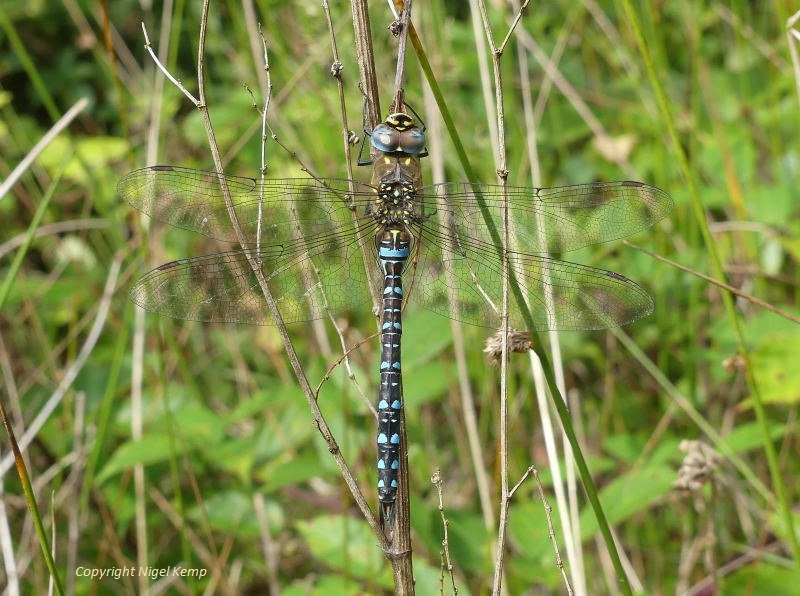
Migrant Hawker (Aeshna mixta) (males)


Willow Emerald Damselfly (Chalcolestes viridis) (males)