Showing posts with label Predation. Show all posts

Thursday, 11 February 2021

Predation

 Modern European Homo sapiens has largely lost the ability to go out into the wild to feed himself and his family. The use of his hunter-gatherer skills are pretty much confined to pushing a trolley up and down the aisles of the local supermarket.

However, in the wider natural world, the battle to survive is never ending and the contest between predator and prey is played out everywhere. The predator must eat to survive and the prey species must stay alert to avoid being eaten.

When I am out in the field, I regularly happen upon such survival dramas and I have put together some images from my photo-library.


Sparrowhawk (Accipiter nisus)

This is the top avian predator that you are most likely to see in action in a suburban garden.

The first three images are of a female feeding on a House Sparrow catch and the last two images are of a male feeding on a Goldfinch catch.


Invertebrate predators adopt many different strategies for catching prey. The top predators are probably dragonflies and spiders but many other invertebrates are efficient hunters.


Hairy Dragonfly (Brachytron pratense)

Male devouring a bee.


Hairy Dragonfly (B. pratense)

This female has caught a beetle and she is happily laying on her back as she grapples with her prey.


Brown Hawker (Aeshna grandis)

Male devouring a Meadow Brown butterfly.


Kite-tailed Robberfly (Machimus atricapillus)

Devouring a male Common Blue butterfly.


A mating pair of a Robberfly sp. with Hoverfly catch.


Crab Spider sp. (Misumena vatia)

Crab Spiders are ambush specialists and lay in wait on flower heads for their prey to arrive. They are able to change colour to match their background.

The first image shows a white vatia that has caught a Small White butterfly and the second image shows a yellow vatia laying in wait on a flowerhead (left) as a Small Copper butterfly nectars on a neighbouring flowerhead.


Jumping Spider sp. (Evarcha falcata)

Jumping Spiders will stalk their prey. In the following images this falcata has caught the female of a mating pair of Speckled Yellow moths. The male moth eventually disengages from the doomed female.


Devil's Coach-horse Beetle (Ocypus olens)

This beetle is a voracious predator. This one has caught a species of Ground Beetle and is in the process of dismembering the elytra of its seemingly doomed prey. During the struggle, they both fell from the tree trunk they were on and separated on impact with the ground. Battle was not rejoined.


Wasp Spider (Argiope bruennichi)

The female Wasp Spider usually constructs her web amongst long grass and her prey consists mostly of Grasshoppers.


Spiked Shieldbug (Picromerus bidens)

Shieldbugs have sucking mouthparts and mainly prey on caterpillars. In the following image, two Shieldbugs, one of which is mating, are feeding on the larva of a Knot Grass moth.


Friday, 11 December 2020

Larval Development and Parasitism in the Large White Butterfly

 Back in early spring, just as we were entering lockdown, the weather was gloriously warm and sunny. Like many other amateur entomologists, I spent a lot of time in the garden watching the comings and goings of butterflies and other insects. 

Garlic Mustard is a wild plant that is regularly used as a foodplant by several species of Pieridae butterflies and in late April, I watched a female Large White (Pieris brassicae) ovipositing on the underside of a garlic mustard leaf. This would provide a good opportunity to monitor larval development, hopefully through to pupation and the emergence of a summer brood of Large Whites. 

The parasitic wasp Cotesia glomeratus specialises in laying its eggs in the larvae of the Large White (P. brassicae) and can sometimes kill large numbers of caterpillars but the predator-prey cycle always ensures that, over time, numbers of predator and prey species are kept in balance.


Large White (Pieris brassicae


(female ovipositing on garlic mustard)


(egg batch on garlic mustard)


(egg batch showing developing larvae, one day before hatching)


(1st. instar larvae, one day after hatching )


(2nd. instar larvae, with 3rd. or 4th. instar larva wandering along leaf edge)


The following sequence of images show a 5th. instar larva being pestered by attendant Cotesia wasps. The larva is clearly aware of its peril and constantly made attempts to keep them away.


The following image is of a 5th. instar larva with a Cotesia wasp on its back, injecting its eggs.


This final image shows a 4th. or 5th. instar larva surrounded by the pupal cocoons of the Cotesia larvae that have emerged from its body. You can also see a Cotesia larva in the process of emerging from the 5th. segment of the caterpillars body.


This small colony of Large White larvae was overwhelmed by the onslaught wrought by the parasitoids and I am pretty certain that none survived to pupation.


Wednesday, 11 September 2019

Late Summer on Pevensey Levels

Although the evenings are drawing in and an autumnal chill can be felt as the sun goes down, there is still plenty to be seen out in the field.

 The expected emergence of a British brood of Long-tailed Blue (Lampides boeticus) in southern England is likely to be on the wing from the last week of September.

 On Pevensey Levels, a third brood of Wall (Lasiommata megera) should be taking flight soon and I am still hopeful of seeing my first Clouded Yellow (Colias croceus) of the season sometime during October.

 At the moment though it is Dragonflies that rule the water ditches and reed beds.


Small Copper (Lycaena phlaeas) (female, form caeruleopunctata)


A mating pair of Robberflies (probably Machimus atricapillus) with Hoverfly prey (Helophilus pendulus)


Golden-ringed Dragonfly (Cordulegaster boltonii) (males)


Brown Hawker (Aeshna grandis) (male)


Brown Hawker (A. grandis) (female)


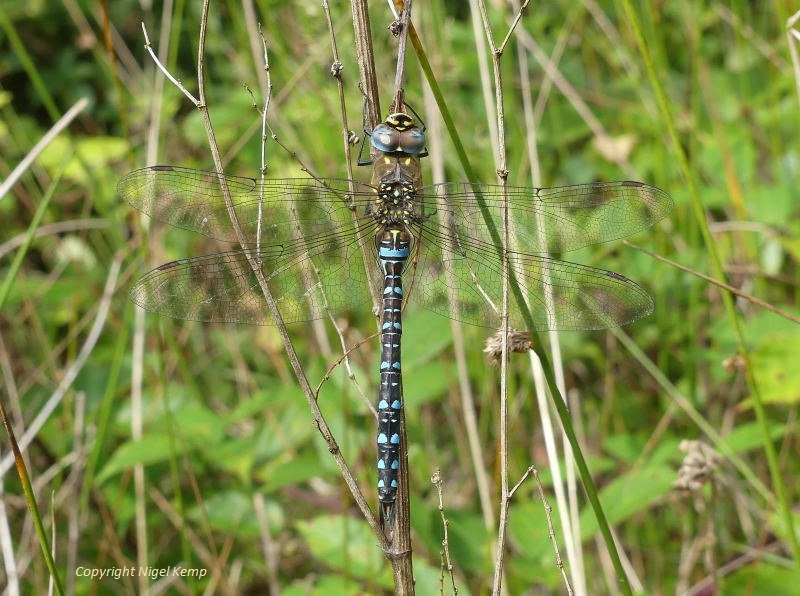
Migrant Hawker (Aeshna mixta) (males)


Willow Emerald Damselfly (Chalcolestes viridis) (males)


Saturday, 18 May 2019

Drama on the Woodland Floor

Whilst we enjoy watching the beauty of the natural world, we are often reminded of just how tough it is to survive in the wild. Walking in one of my local woods last week, I came across a drama unfolding on the woodland floor. 

I noticed a mating pair of Speckled Yellow Moths (Pseudopanthera macularia) near to the ground. On closer inspection, the female had been caught by a species of Jumping Spider (Evarcha falcata).

Initially, the male appeared to be oblivious to the situation but eventually he became aware of his peril, disengaged from the doomed female and took flight. 


Elsewhere in the wood, another Speckled Yellow rests on a bluebell.


Tortoise Shieldbug (Eurygaster testudinaria)


Sunday, 16 December 2018

More from the Cutting Room Floor

This is the time of year when I look back at some of the photographs that I didn't get around to posting. Once the new breeding season gets underway then the life of the amateur naturalist can become rather busy as one tries to keep up with the varying emergence times of different species.
 
 
Puss Moth (Cerura vinula)
 
The larva of the Puss Moth is a fascinating creature and when I found four early-instar specimens feeding on a small sallow bush beside a hedgerow on Pevensey Levels in early June, my intention was to observe them through to maturity. Sadly this was not to be and a week later they had all vanished, probably predated upon by a bird.
 
Apart from the curious postures that the larva adopts, its most obvious feature is the modification of its tail claspers into flagella. When at rest, what you see is the flagellum sheath but when the larva is threatened, the whip-like structures emerge from the sheaths and are waved over its back to deter predators such as parasitic flies.
 
 
Larva feeding on sallow.


Larva in resting posture.


Larva in defensive posture with flagella being waved over its back.


Three ova on a sallow leaf, two of which are showing emergence holes.


Common Wasp (Vespula vulgaris)
 
Whilst checking out a local Wealden pond for any interesting damselflies back in early September, I noticed that several Wasps were walking about on the lily pads. On closer inspection they were feasting on tiny aphid-like creatures that were emerging from the water in abundance and leaving their shed skins floating on the water surface.


Rhododendron Leafhopper (Graphocephala fennahi)
 
This non-native species of bug has been established in southern England since the early 20th century. A native of North America, I spotted this mating pair on a rhododendron leaf in a National Trust garden in August. Once I had got my eye in, there were thousands of them!