The weather during April was warm and sunny but the start of May was very changeable with blustery showers and occasional sunny spells. However, by the end of May we were experiencing a heat wave with temperatures touching 30 degrees centigrade and not a cloud to be seen anywhere.
Here are some images taken over the last two months on Pevensey Levels.
Large White (Pieris brassicae)
(freshly emerged male)
%20Large%20white%20m%204.4.26.JPG)
%20Large%20white%20m%204.4.26.JPG)
(mating pair)
%20Large%20white%20mating%208.5.JPG)
Green-veined White (Pieris napi) (female)
%20gvw%20f.JPG)
Small Heath (Coenonympha pamphilus)
%20Small%20Heath.JPG)
Red Admiral (Vanessa atalanta) (5th instar larva on nettle)
This one was found in the open on the nettle plant and probably looking to construct a new larval tent.
%20Red%20Admiral%20larva.JPG)
%20Red%20Admiral%20larva.JPG)
Small Tortoiseshell (Aglais urticae)
By the 17th. May, the spring brood was starting to emerge.
%20Small%20Tort.JPG)
Common Blue (Polyommatus icarus) (male)
%20Common%20Blue.JPG)
On the last day of May I saw my first Meadow Brown of the year and there was a significant landfall of Painted Ladies from the near continent, with dozens nectaring on bramble blossom.
Meadow Brown (Maniola jurtina) (male)
%20Meadow%20Br%20m.JPG)
Painted Lady (Vanessa cardui)
%20Painted%20Lady.JPG)
Hairy Dragonfly (Brachytron pratense) (male)
%20Hairy%20Dragonfly%20m.JPG)
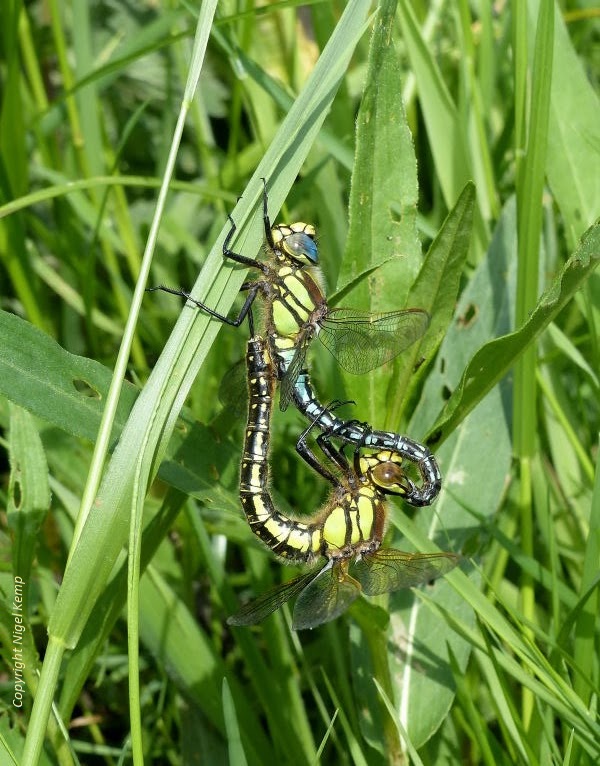
(mating pair)
%20Hairy%20Dragonfly%20mating.JPG)
Four-spotted Chaser (Libellula quadrimaculata) (male)
%20Four-spotetd%20Chaser%20m.JPG)
Azure Damselfly (Coenagrion puella) (male)
%20Azure%20m.JPG)
Variable Damselfly (Coenagrion pulchellum) (male)
%20Variable%20m.JPG)
Blue-tailed Damselfly (Ischnura elegans) (male)
%20Blue-tailed%20m.JPG)
Large Red Damselfly (Pyrrhosoma nymphula) (female)
%20Large%20Red%20f.JPG)
Common Lizard (Lacerta vivipara) (juvenile/sub-adult)
%20Juv%20lizard.JPG)
To finish, I came across these predated Moorhen eggs scattered in the grass beside a reed ditch. The culprit is likely to be a crow. I placed them together for the photograph.
%20Moorhen%20egg%20predation.JPG)

%20Peacock.JPG)
%20Orange-tip.JPG)
%20Satellite%20(larva).JPG)
%20Broad-bodied%20Chaser.JPG)
%20Four-spotted%20Chaser.JPG)
%20Pyrochroa%20coccinea%20(Black-headed%20Cardinal).JPG)
%20Pyrochroa%20serraticornis%20(Red-headed%20Cardinal%20Beetle).JPG)
%20Green%20Tiger%20Beeyle%20(mating).JPG)
%20Cicindela%20campestris%20(Green%20Tiger%20Beetle)%20(ovipositing).JPG)
%20Sabre%20Wasp.JPG)
%20Sabre%20Wasp.JPG)
%20Sabre%20Wasp.JPG)
%20Sabre%20Wasp.JPG)
%20Oak%20Sawfly%20larva.JPG)
%20Tenthredo%20livida.JPG)
%20Tenthredo%20livida.JPG)
%20Tenthreda%20mesomela.JPG)
%20Rhogogaster%20viridis.JPG)