Showing posts with label Broad-bodied Chaser. Show all posts

Sunday, 16 July 2023

Dragonflies along the Woodland Edge

 Dragonflies are one of the top predators in the insect world. When you watch them flying along the woodland edge hunting for prey, it is easy to see why they have names like Hawker, Chaser and Darter.

Here are some images of these stunning creatures taken during the last few weeks.


Broad-bodied Chaser (Libellula depressa) (male)


Scarce Chaser (Libellula fulva) (male)


Scarce Chaser (L. fulva) (immature male)


Black-tailed Skimmer (Orthetrum cancellatum) (male)


Black-tailed Skimmer (O. cancellatum) (immature male)


Emperor Dragonfly (Anax imperator) (male)


Norfolk Hawker (Aeshna isosceles)


In the UK, the Norfolk Hawker populations were only to be found in the Norfolk Broads and have seemingly been stuck there for many decades. However, within the last decade or so, isosceles has been breeding in north Kent and in 2018, I myself witnessed how numerous this species has become along the Suffolk coast around Aldeburgh. In recent years, isosceles has been recorded in Sussex and this year I have seen several flying around in my local East Sussex woods. 

To me, it seems highly unlikely that isosceles has started to spread out from its Norfolk haunts. It is a common species in Europe and it is much more likely that it has followed several other species across the channel to set up home in south-east England.


Norfolk Hawker (Aeshna isosceles)

(male)


(female)


Monday, 19 June 2023

Along the Woodland Edge

 The woodland edge is made up of several different growth layers. Most woodland tracks are bordered by verges of grass and flowers which are backed by a scrub layer of plants such as bramble and bracken. Deciduous saplings such as birch, aspen and willow grow though the scrub and these are backed by mature trees such as oak, beech and pine. The aspect of these track-sides dictates whether they face the sun or are left in shade. Together, all these features provide many different niche habitats for wildlife, especially invertebrates.

Here are some images of what can be found during May and June.


Peacock (Aglais io)


Orange-tip (Anthocharis cardamines)

The male is courting this female who is showing her reluctance to mate by holding up
her abdomen.


Satellite (Eupsilis transversa) (larva on bramble)

This moth larva is a nocturnal feeder but constructs a shelter in which to rest during daylight hours.


Broad-bodied Chaser (Libellula depressa) (female)

Although dragonflies need water for breeding, they utilise the woodland edge to hunt for insect prey.


Four-spotted Chaser (Libellula quadrimaculata) (female)

This immature female is developing the wing markings of form praenubila.


Black-headed Cardinal Beetle (Pyrochroa coccinea)


Red-headed Cardinal Beetle (Pyrochroa serraticornis)


Green Tiger Beetle (Cicindela campestris)

This species is regularly seen on woodland tracks. 

The images show a mating pair and an ovipositing female.


Sabre Wasp (Rhyssa persuasoria) (female)

This species is the largest Ichneumon Wasp to be found in Britain. The female has an ovipositor that makes up half of her total length. 

 I came across this female busily preening herself. She measured about 8 cms.


Oak Sawfly (Periclista lineolata) (larva)

Its foodplant is oak but I found this one resting on a nettle leaf.


Tenthredo livida (Sawfly sp.)


Tenthredo mesomela (Sawfly sp.)


Rhogogaster viridis (Sawfly sp.)


Thursday, 14 May 2020

Nocturnal Visitors and Heavenly Bodies

During the last week, the moth-trap has continued to attract an ever increasing variety of species although the overall number of moths is still fairly low.

 One of my favourite moth families are the Prominents. They get their name from the protruding tufts on the trailing edge of their forewings which help break up their outline when they are at rest.


Lesser Swallow Prominent (Pheosia gnoma)


Coxcomb Prominent (Ptilodon capucina)


Buff-tip (Phalera bucephala)


Pale Tussock (Calliteara pudibunda) (male)


Treble Lines (Charanyca trigrammica)


One surprise visitor to the moth-trap last week was a male Palmate Newt (Lissotriton helveticus) which was resting in the grass next to the light. The male is distinguished from the female by a dark stripe through the eye and webbed hind feet during the breeding season.


Palmate Newt (Lissotriton helveticus) (male)


A few days ago, we had our first dragonfly of the year to visit the garden.


Broad-bodied Chaser (Libellula depressa) (immature male)


On the 26th April, I looked up into the night sky and noticed how brightly Venus was shining. It was quite near the Moon (as viewed from Earth) and both were just above the horns of the constellation of Taurus.

My mind is continually boggled by the dimensions of the Solar System (never mind trying to get my head around the dimensions of the Universe).

 I am one human who likes to know where the boundaries are!

Although Venus is about 40 million kilometres from Earth, I managed to get the following, rather abstract image of Venus by hand holding my bridge camera on full zoom.

As I say, mind boggling. 


Friday, 18 May 2018

A Wealden Woodland Glade

The display of bluebells spread out across the woodland floor has pretty much been at its peak this week and it has been a real joy to stand in a scented glade and watch male Pearl-bordered Fritillarys (Boloria euphrosyne) patrolling back and forth in search of females. Dragonflies hawk along the woodland edge in search of prey and occasionally take a rest in the late afternoon sunshine.
 
 
Pearl-bordered Fritillary (Boloria euphrosyne) (female)


Pearl-bordered Fritillary (B.euphrosyne) (males)


Broad-bodied Chaser (Libellula depressa) (female)


Small Copper (Lycaena phlaeas) (male)


Dark-edged Beefly (Bombylius major)


My first Hawkmoth of the season was attracted to the garden light-trap earlier this week.
 
 
Lime Hawkmoth (Mimas tiliae) (male)


Sunday, 4 June 2017

Walking on Water

I have been seeing Fen Raft Spiders (Dolomedes plantarius) regularly over the last couple of weeks on Pevensey Levels. This week, I caught sight of an adult male walking across the water surface towards me. It came to rest in the margin of the ditch where it was well camouflaged among the stem shadows.
 
 
Fen Raft Spider (Dolomedes plantarius) (male)


I also came upon a female Wall (Lasiommata megera) in the process of looking for egg laying sites. She was slowly fluttering along a track edge and amongst the young grass shoots to oviposit.
 
 
Wall (Lasiommata megera) (ovum on grass shoot) 


Calling in at Batemans one afternoon this week to check the ponds, there were several species of Odonata on the wing.
 
 
Broad-bodied Chaser (Libellula depressa) (male)


Looking into the shallows of a wealden stream, a Brown Trout (Salmo trutta) watches the Beautiful Demoiselles (Calopteryx virgo) flying low across the water.
  
 
Brown Trout (Salmo trutta)


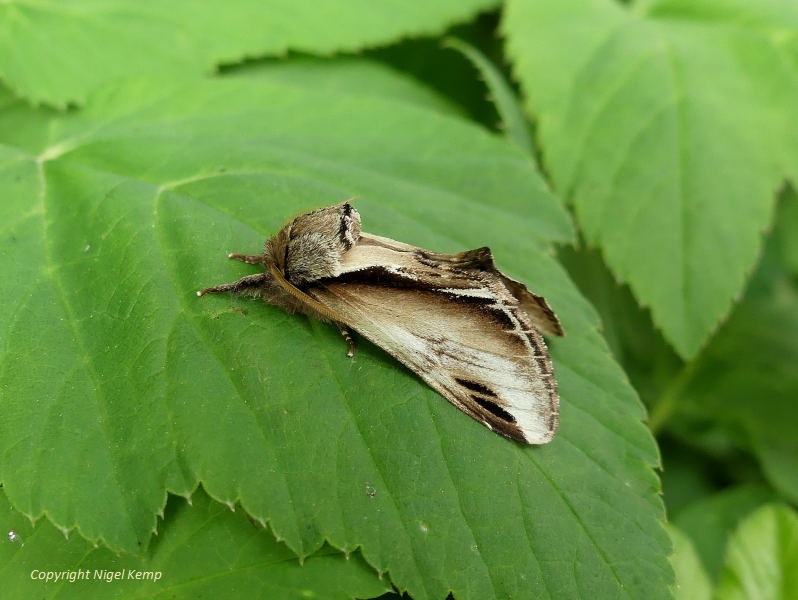
This beautiful moth made its first appearance of the year at the garden light trap this week. It is another member of the Prominent family and gets its name from its strange looking larva. 
 

Lobster Moth (Stauropus fagi)