Showing posts with label Metamorphosis. Show all posts

Sunday, 27 June 2021

A Glimpse into the Metamorphosis of the White Admiral

 Following on from my blog post from 2017 entitled "Life Cycle of the White Admiral", this year I was keen to observe more of the life cycle of the White Admiral (Limenitis camilla), in particular the development of the pupa and emergence of the adult butterfly. I was equally keen to make these observations in the wild.

 I began my search for a fifth instar larva during the last week of May and on the 27th. I found a candidate busily feeding on honeysuckle, about 6 feet from the ground.

For the next four weeks I was able to make almost daily visits to monitor its progress.

The photographs were taken in subdued light. I have not used any flash so as to show the larva and pupa at one with their natural surroundings.


27th May, 5th. instar larva feeding on honeysuckle.


27th May, same larva in defensive posture.


2nd, June, larva at rest.


4th, June, the larva is resting on top of a leaf on a very wet day.


7th. June, final instar larva preparing to pupate.


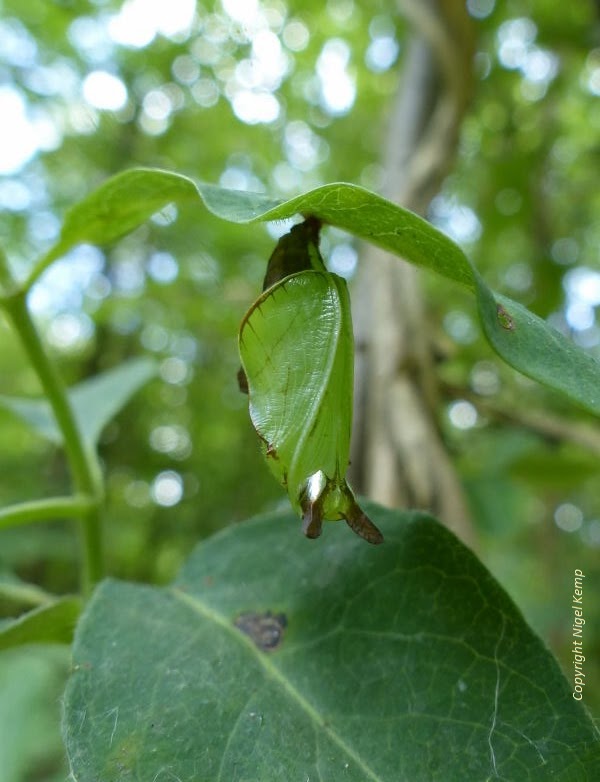
8th. June, the larva has shed its final skin and pupated (day 1)

The reflective mirrors are yet to develop.


9th. June, the pupa (day 2)

The silver-gilt mirrors are developing.


14th. June, the pupa (day 7)


20th. June, the pupa (day 13)

The pupa of the White Admiral is a wonderful piece of evolutionary design and although it has the look of a folded honeysuckle leaf, I think that the pupa is a master of illusion. When it is seen against a woodland background, with all its shadows and reflections, the silver-gilt mirrors and dark markings and projections very successfully break up the outline and form of the pupa. On several occasions, even though I knew where it was, I looked past it before I eventually focused on it.


22nd. June, the pupa (day 15)

There is an almost imperceptible change as the green colour starts to dull and the head darkens.


23rd. June, the pupa (day 16)

The darkening of the green areas have become more obvious.


24th. June, the pupa (day 17)

The pupa is now much darker and the wing markings are just starting to show through the pupal membrane.


25th. June, the pupa (day 18)

The pupa is now virtually black and the white wing markings are clearly visible through the pupal membrane.


26th. June, the pupa (day 19)

Translucent areas on the pupa show that the butterfly within has separated from the pupal membrane.
Emergence is imminent. 


26th. June, the pupal membrane breaks open and the butterfly emerges.


A male White Admiral is ready for its first flight.


Sunday, 9 December 2018

Life Cycle of the Comma

The Comma (Polygonia c-album) is an attractive member of the Nymphalidae family. It has a rich orange ground colour with dark markings which can be quite variable in their detail and it has strikingly jagged wing edges. The underside is cryptically marked in browns and greys and there is a prominent white 'c' mark on the hind wing that gives this species its name. The sexes are very similar but the female generally has slightly less jagged wings.
 
 It is a double-brooded species and hibernates as an adult butterfly, emerging in early spring to breed. The summer brood, resulting from eggs laid in spring, produces a paler orange butterfly with slightly reduced dark markings. This is form hutchinsoni which accounts for about a third of the summer brood. A second brood is produced in late summer and early autumn which goes into hibernation for the winter.
 
 
Comma (Polygonia c-album) (male)


Comma (P. c-album) (female) (form hutchinsoni)


Comma (P. c-album) (male)
 
This specimen has just come out of hibernation and is enjoying some early March sunshine. It is displaying quite pale wing borders. 


Comma (P. c-album) (male) (ab. obscura)
 
In this aberration, the wing borders are blurred and indistinct and the hind wing markings have become fused and blotched.


Comma (P. c-album) (roosting male)


Comma (P. c-album) (ovum on nettle)


Comma (P. c-album) (final instar larva on nettle)
 
The Comma larva is a classic bird-dropping mimic.


Comma (P. c-album) (pupation)
 
The following sequence shows the emergence of a fresh pupa as the larva sheds its final skin.


Comma (P. c-album) (pupa)
 
After a couple of days, the pupal membrane has fully hardened and has adopted its usual brown colour with reflective mirrors.


Saturday, 25 November 2017

Life Cycle of the White Admiral

Now that autumn is moving towards winter, much of my time will be spent working in the wood. Rhododendron and bracken control is always on the agenda but coppicing, ride widening and wood thinning are essential in order to maximise potential breeding habitat for butterflies and moths.
 
Historically, most of our (now rare) woodland fritillary species would have been common in our wood. However, species such as the Pearl-bordered (Boloria euphrosyne), Small Pearl-bordered (Boloria selene) and Heath (Melitaea athalia) Fritillaries are highly unlikely to return naturally. I therefore focus my efforts on keeping the habitat right for species like the White Admiral (Limenitis camilla), which breeds in the wood in small numbers and also to encourage the Silver-washed Fritillary (Argynnis paphia) to increase its tiny population.
 
 
Life Cycle of the White Admiral (Limenitis camilla)
 
During the winter months, the White Admiral (L.camilla) hibernates as a tiny larva. It emerges from its hibernaculum in early spring and is fully grown by the end of May or early June. The pupa stage lasts for 2-3 weeks and the adult butterflies are usually on the wing from mid-June until the end of August. The ova are laid on honeysuckle leaves and the next generation of young larvae will start to build a new hibernaculum for the coming winter. 
 
 
A third instar larva remains close to its hibernaculum and a recently shed skin can be seen just above and behind the larva. (20th April 2015)


A fourth instar larva on honeysuckle. (28th April 2017)


A fifth instar larva on a honeysuckle stem. (21st May 2017)


The same larva is suspended from a stem node of honeysuckle about 15 feet from the ground and in 90% shade. (27th May 2017)


Two hours later and the larva has shed its final skin. The pupal membrane is yet to harden.
 (27th May 2017)


The same pupa (dark form).  (29th May 2017)


The same pupa (dark form). The pupa in this species has evolved to look like a crumpled honeysuckle leaf. The shadowy markings and reflective mirrors are clearly designed to break up its outline and make it less visible to predators. (4th June 2017)


Another final instar larva prepares to pupate beneath a honeysuckle leaf about 7 feet from the ground.
(31st May 2017)


The next day, the same larva has pupated. (1st June 2017)


The same pupa has adopted the more usual colour form. (2nd June 2017)


The same pupa. (4th June 2017)


The same pupa. (9th June 2017)


Sadly, the same pupa has been predated upon by a bird. Only the cremaster remains attached to the underside of the leaf. (11th June 2017)


The following three photographs are of a male White Admiral, freshly emerged from the dark form pupa. The left antenna is missing its tip and its left foreleg appears to be paralysed. After it had hardened its wings, I watched it fly up into the woodland canopy. (14th June 2017) 


The recovered pupa case shows that the pupa has sustained an injury or damage during its development. This has clearly interfered with the formation of the left antenna and is probably the cause of the paralysis in the left foreleg. (15th June 2017) 


My camera is not ideal for taking photographs of a pin-head sized ovum in subdued light but this image shows that the ovum is typically laid on the upper edge of a honeysuckle leaf.
(8th August 2017) 


The following photographs are of a second instar larva constructing its hibernaculum in preparation for the coming winter. The larva was about 6mm in length. (8th August 2017)