Friday, 1 October 2021

Early Autumn on Pevensey Levels

 My spring and summer walks on Pevensey Levels this year were more often than not blighted by cool and blustery weather. By late September however, I was able to enjoy some walks in warm sunshine and still conditions.

Such weather conditions provide a better opportunity to find Fen Raft Spiders (Dolomedes plantarius) basking out in the open.

There are also other things of interest to be found along the field edges and ditch margins  


Fen Raft Spider (Dolomedes plantarius) (female with egg sac) 


Peacock (Aglais io) (larvae on common nettle) 

The Peacock is normally a single brooded butterfly. Its larvae are usually found in May and June but in recent years, a second brood has become an increasingly regular occurrence.


I found  this colony of larvae on 21st. September.


By 25th. September the final instar larvae had dispersed and should produce an emergence of adults during the latter half of October.


Reed Dagger (Simyra albovenosa) (larva on reed)

The Reed Dagger is a nationally scarce moth found in wetland habitats in the south-east of England.

This larva was spotted by my daughter as we walked along the ditch margins on 20th. September and it is nice to know that this species is breeding on Pevensey Levels.


Sunday, 26 September 2021

Wasp Spider

 I first came across a female Wasp Spider (Argiope bruennichi) on the Isle of Wight, back in the early 1990's. In those days it was a rare find but nowadays it is a common species in southern England.

There is no mistaking this stunning creature for any other species of spider and whilst many of us shudder at the sight of a house spider galloping across the living room carpet, I have no qualms about getting close to this beauty.

Not only is the spider itself easily identified but its web is also very distinctive, usually bearing one or more zig-zag features in its structure.

The peak of the Wasp Spiders breeding season occurs during August when sometimes many females can be found sitting in the middle of their webs, low down in long grass.


Wasp Spider (Argiope bruennichi)

(female)


It is often said that every picture tells a story and that is certainly true of the following image. 

Approaching the female Wasp Spider is rather hazardous for the much smaller male. The female regularly eats the male either after or during mating and he must choose his moment carefully if he is to escape after a successful mating. That moment is generally just after the female has shed her old skin and before her new skin and mouthparts have hardened.

In the following image, the shed skin of the female can be seen in the web above her. Above that, a male spider sits at the periphery of the web contemplating his approach.

On the left of the female are the remains of another spider that she has devoured. This was either an unsuccessful male or another species of spider that wandered too close.


This male awaits his chance to approach a female on another web.


This female is feeding on a grasshopper (their main prey) that has leapt into her web.


The flask shaped egg sac of the Wasp Spider can be quite variable in size but the following image is of the largest one I have ever found, measuring 4cms. in length.


Saturday, 28 August 2021

Late Summer in a Wealden Wood

 August is the month when the nights definitely start to draw in and a nip in the evening air hints that autumn is not far away. Summer species of butterflies are now showing signs of age but late summer species and broods are looking fresh.


Silver-washed Fritillary (Argynnis paphia) (post-copulation)

This pair rest together for a while after mating before the male flies of and leaves the female to bask in the sun.


Common Blue (Polyommatus icarus) (female)


Whilst the Common Blue is very much at home in woodland glades, the Chalkhill Blue is most definitely a chalk downland species. However, when their populations erupt in good years, they do wander from their breeding grounds. I have seen them in wealden woods before but it still seems odd to see one flying around a marshy meadow about 5 miles from its nearest downland colony.


Chalkhill Blue (Polyommatus coridon) (male)


Small Tortoiseshell (Aglais urticae)


Painted Lady (Vanessa cardui)


Peacock (Aglais io)


Speckled Wood (Pararge aegeria) (male)


Emperor Dragonfly (Anax imperator) (male)


Sunday, 8 August 2021

Gynandromorph

 Earlier this week, as I walked around one of my favourite Wealden woods, I encountered an extraordinary butterfly and a lifetime first for me.

As I moved slowly past some bramble beds, I noticed a slightly worn looking Silver-washed Fritillary (Argynnis paphia) nectaring on bramble flowers. I barely took much notice of it but as it started moving around the blossom, its wings on either side were clearly different shades. I could see that this was a very special butterfly.

This paphia was gynandrous, meaning that its markings were displaying both male and female traits. More specifically it was a bilateral gynandromorph meaning that it is exactly half  male and half female, with the dividing line running down the centre of its body.

Gynandromorphism is an extremely rare occurrence in nature. When a sperm fertilises an egg to form a zygote, a fault can then occur during the first cell division (mitosis) whereby a sex chromosome is lost from one of the daughter cells. In the case of bilateral gynandromorphs, the continuing cell division ultimately produces a butterfly that is half male and half female.


Silver-washed Fritillary (Argynnis paphia)

Bilateral gynandromorph (male on left, female on right)


Sunday, 25 July 2021

A Walk in the Woods in July

During the hot days of July, I have enjoyed my woodland walks mainly in the early mornings or late afternoons when the heat is less stifling.

 Woodlands are alive with insects at this time of year and I get great pleasure in just dawdling about slowly, peering into the undergrowth and casting my eyes over the bracken beds to see what can be found.


Emerald Damselfly (Lestes sponsa)

(female)


(immature male)


Emperor Dragonfly (Anax imperator) (male)


Black-tailed Skimmer (Orthetrum cancellatum)

(immature male)


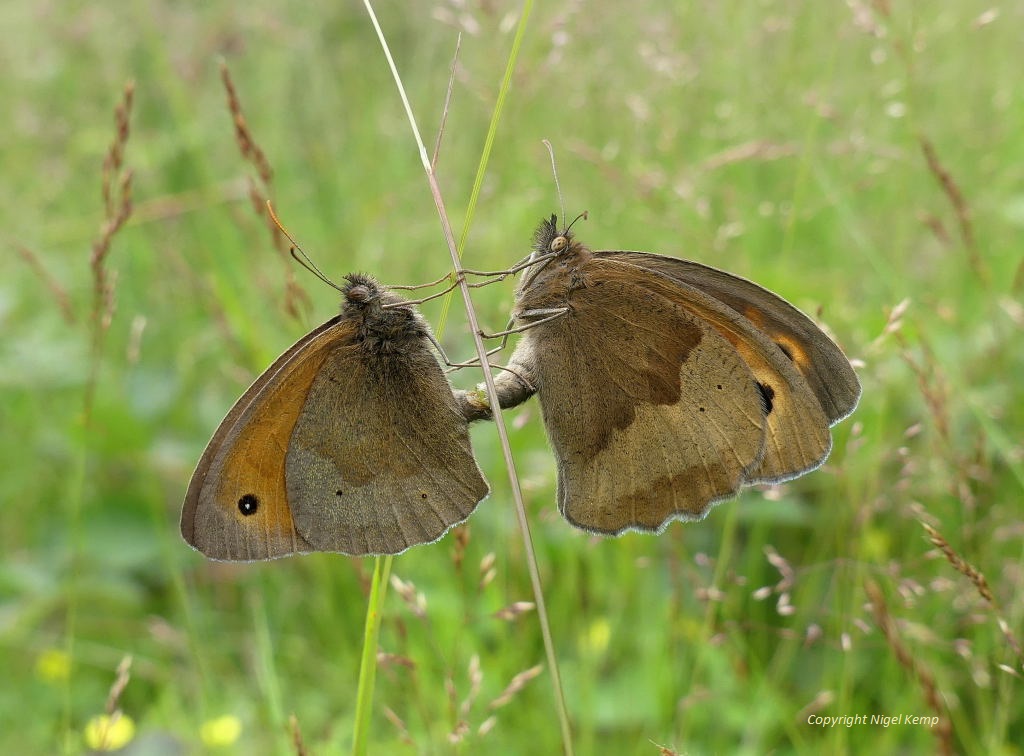
Meadow Brown (Maniola jurtina) (mating)


Comma (Polygonia c-album) (female)

(form hutchinsoni)


Small Skipper (Thymelicus sylvestris) (female)


Figwort Sawfly (Tenthredo scrophulariae)

(mating)


(male preening)


Sunday, 27 June 2021

A Glimpse into the Metamorphosis of the White Admiral

 Following on from my blog post from 2017 entitled "Life Cycle of the White Admiral", this year I was keen to observe more of the life cycle of the White Admiral (Limenitis camilla), in particular the development of the pupa and emergence of the adult butterfly. I was equally keen to make these observations in the wild.

 I began my search for a fifth instar larva during the last week of May and on the 27th. I found a candidate busily feeding on honeysuckle, about 6 feet from the ground.

For the next four weeks I was able to make almost daily visits to monitor its progress.

The photographs were taken in subdued light. I have not used any flash so as to show the larva and pupa at one with their natural surroundings.


27th May, 5th. instar larva feeding on honeysuckle.


27th May, same larva in defensive posture.


2nd, June, larva at rest.


4th, June, the larva is resting on top of a leaf on a very wet day.


7th. June, final instar larva preparing to pupate.


8th. June, the larva has shed its final skin and pupated (day 1)

The reflective mirrors are yet to develop.


9th. June, the pupa (day 2)

The silver-gilt mirrors are developing.


14th. June, the pupa (day 7)


20th. June, the pupa (day 13)

The pupa of the White Admiral is a wonderful piece of evolutionary design and although it has the look of a folded honeysuckle leaf, I think that the pupa is a master of illusion. When it is seen against a woodland background, with all its shadows and reflections, the silver-gilt mirrors and dark markings and projections very successfully break up the outline and form of the pupa. On several occasions, even though I knew where it was, I looked past it before I eventually focused on it.


22nd. June, the pupa (day 15)

There is an almost imperceptible change as the green colour starts to dull and the head darkens.


23rd. June, the pupa (day 16)

The darkening of the green areas have become more obvious.


24th. June, the pupa (day 17)

The pupa is now much darker and the wing markings are just starting to show through the pupal membrane.


25th. June, the pupa (day 18)

The pupa is now virtually black and the white wing markings are clearly visible through the pupal membrane.


26th. June, the pupa (day 19)

Translucent areas on the pupa show that the butterfly within has separated from the pupal membrane.
Emergence is imminent. 


26th. June, the pupal membrane breaks open and the butterfly emerges.


A male White Admiral is ready for its first flight.