Sunday, 26 April 2020

My First Cuckoo of the Year

Yes, I did hear my first Cuckoo of the year yesterday morning whilst I was sitting in the garden. 

However, the 'cuckoo' that I am referring to is my first Cuckoo Wasp of the year.

 When you take a close look at these tiny wasps, it is clear to see why they are also known as Jewel Wasps as they sport a sparkling blue, green and pink livery. I delight in watching them patrolling my house wall every year. 

They are parasitic wasps that specialise in laying their eggs in the nest holes of solitary wasp and bee species.


Ruby-tailed Wasp (Chrysis ignita) 


After removing the old crazy-paving outside my back door a couple of years ago to redesign the area, I decided to allow a newly created flower bed to re-wild itself. The intention is to selectively weed out the vigorous 'monster' weeds and allow the more delicate wild flowers to thrive. Garlic mustard is a food plant for Large, Small and Green-veined Whites as well as the Orange-tip and it is flourishing. I am eager to see what other butterfly foodplants might appear during the course of the summer.

A couple of days ago, a female Large White stopped off at the scrub meadow to lay her eggs under a garlic mustard leaf.


Large White (Pieris brassicae) (ovipositing female)


The resulting batch of ova.


A few more moths from the moth-trap this week.


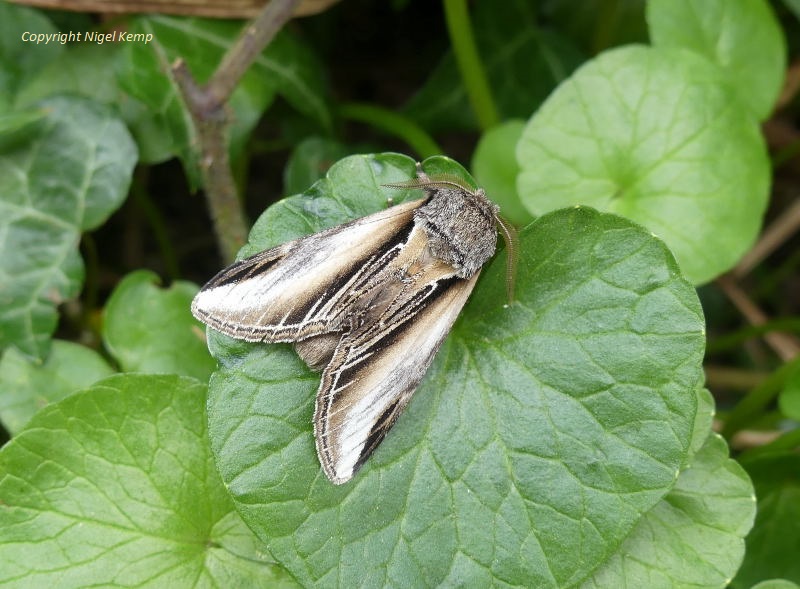
Mullein (Shargacucullia verbasci)


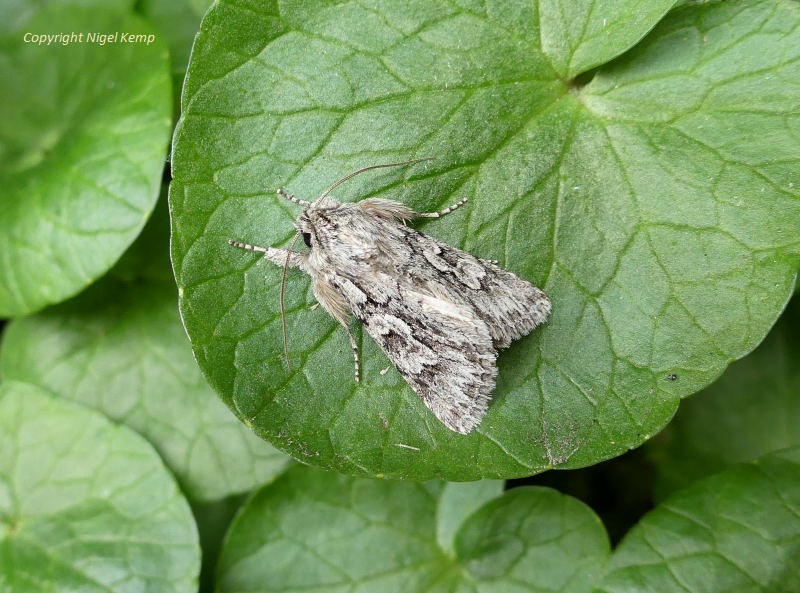
Angle Shades (Phlogophora meticulosa) 


Frosted Green (Polyploca ridens)

Friday, 17 April 2020

More Views from the Terrace

Judging by the numbers of Holly Blue (Celastrina argiolus) that have been flying through the garden over the last week, they seem to be having a good year. Over the Easter weekend I noticed a Holly Blue fluttering back and forth along our holly hedge and it had the look of a female looking for suitable egg laying sites. I grabbed my camera and watched her at close quarters for 20 minutes or so.

It was indeed a female laying eggs on the holly flower buds. Females of the spring brood mainly lay their eggs on holly buds but females of the summer brood tend to lay their eggs on ivy buds. I have also occasionally seen them use alder buckthorn and spindle as a food plant.

I managed to get the following images. 


Holly Blue (Celastrina argiolus) (ovipositing female)


The ovum is a pale blue mini urchin and is laid at the base of a holly flower bud.


The Dark-edged Beefly is fairly common in our garden and I noticed this mating pair. 


Dark-edged Beefly (Bombylius major) (mating)


A greater variety of species are now starting to turn up at the moth-trap.


Brindled Beauty (Lycia hirtaria) (male)


Brindled Pug (Eupithecia abbreviata)


Brimstone Moth (Opisthograptis luteolata)


Swallow Prominent (Pheosia tremula)


Thursday, 9 April 2020

View from the Terrace

My garden shed had been suffering from the ravages of time for a few years and finally, during the gales of late winter, it succumbed and had to be dismantled. Apart from a couple of bikes and folding chairs, most of what it contained was junk and so I decided that we didn't really need to replace it. After some rearranging of potted plants, the shed base was quickly converted into my new, rather grandly named sun terrace.

As the coronavirus lock-down has become the new norm, I have taken to spending time sitting on 'the terrace' with my binoculars and copious cups of tea to watch for insects in the garden.

Since last weekend, I have seen several of our spring emerging species pass through. Small Whites and Holly Blues have been numerous and I have seen one each of Large White and Speckled Wood.

Only a Small White stopped for a photograph.


Small White (Pieris rapae) (female)


I have also been watching the Mason Bees patrolling my south-facing house wall. Half-a-dozen continually checked every hole and crevice in the brickwork but never seemed to make any decision as to which ones they liked. If they land, it is only for a brief second or two before they are off again but later in the day they are partial to basking on some drying bay leaves that I have got hanging on the wall.

 I think that the white hairs on their faces identify them as Red Mason Bees.


Red Mason Bee (Osmia bicornis)


And a few more moths from the moth-trap during the last week.


Streamer (Anticlea derivata)


Early Grey (Xylocampa areola)


Chestnut (Conistra vaccinii)


Sunday, 29 March 2020

Garden Lepidoptera

As we all have to get used to new routines during the pandemic lock-down, most of my lepidopteral pleasures will be provided by my garden moth-trap during the coming months. 

Although the weather in recent days has been bright and sunny, the nights have been rather cool and breezy and I have only managed to get the moth-trap out on a couple of occasions so far this spring.

Here are a couple of early season species from the catches thus far.


Oak Beauty (Biston strataria)


Hebrew Character (Orthosia gothica)


Tuesday, 17 March 2020

Butterfly Awakenings

Our winter has been a very mild one but the hope of seeing any early appearances of our hibernating butterflies has been rather delayed by the stormy weather of recent weeks. What was needed was a nice warm and sunny day with no wind, to entice them from their winter slumber. That day arrived on Monday 16th March.

I set off for Pevensey Levels to enjoy this beautiful day and to look for some butterfly activity. I was not disappointed and saw 7 Peacocks (Aglais io) and 2 Commas (Polygonia c-album).


Peacock (Aglais io)


Comma (Polygonia c-album)


Earlier in the month I visited another favourite downland dewpond in search of Newts.


Smooth Newt (Lissotriton vulgaris)

Male.


Females.


Thursday, 27 February 2020

Breeding Toads

Despite having to scrape the windscreen yesterday morning, it was a bright and breezy day and I set off for a walk on the downs to check one of my favourite dewponds for any signs of toad activity. 

Usually by the first week of March, this pond is heaving with breeding toads but on my arrival it looked very much like the main event was nearly over. 

This should really be no surprise, as the winter has been unusually mild.

 I normally expect to see dozens of breeding toads but I only saw about five pairs. However, the pond side was absolutely clogged with spawn, signalling that many pairs had already been and gone.


Common Toad (Bufo bufo)


During the breeding season, the highly charged males will fight each other off in a frenzied attempt to grasp a female and she can disappear into a ball of writhing males. Occasionally, sadly, females are accidentally drowned. I think that this is what has happened to the female in the following image. There were no signs of her having been predated upon.


Back on 5th February, Bob and I saw our first Red Admiral (Vanessa atalanta) of the year whilst we were walking on Ashdown Forest.

Essentially a migrant to our shores, this species has only relatively recently been able to survive the winter in Britain. It is a continuously breeding species and does not have the ability to hibernate. Many fly south in the Autumn but some overwinter as adults or larvae. Adult butterflies need to roost during inclement weather and they must go in search of food during sunny and mild spells in order to stay alive.

The heathland of Ashdown Forest provides plenty of thick insulating layers of dead bracken in which to roost and plenty of winter-flowering gorse to nectar upon.


Red Admiral (Vanessa atalanta)


Wednesday, 5 February 2020

Emperor

To the best of my knowledge, there are only three resident insects occurring in Britain which have the name Emperor in their title.

When a species bears such an epithet, you can be assured that you will be looking at a striking and magnificent creature.

Whilst I impatiently await the start of Spring, here are some images of those three Emperors.


Emperor Moth (Saturnia pavonia)

Female.


Mature larva on heather.


Male.


Emperor Dragonfly (Anax imperator)

Male.


Female.


Ovipositing female.


Nymph.


Exuviae.


Purple Emperor (Apatura iris)

Male.


Female.