Thursday, 30 December 2021

Some Moths during December and a Sleeping Beauty

Opportunities to set the moth-trap up during December can be few and far between but there were several mild nights in the lead up to Christmas which enabled me to put the trap out.

At this time of year, the moths attracted to the light are either winter specialists or hibernators that have been woken by mild conditions.


December Moth (Poecilocampa populi) (male) 


Mottled Umber (Erannis defoliaria) (male)


Scarce Umber (Agriopis aurantiaria) (male)


The next two species are micro-moths that hibernate in the adult stage and I regularly see them on mild days during the winter, when I am working in the woods.


Agonopterix arenella
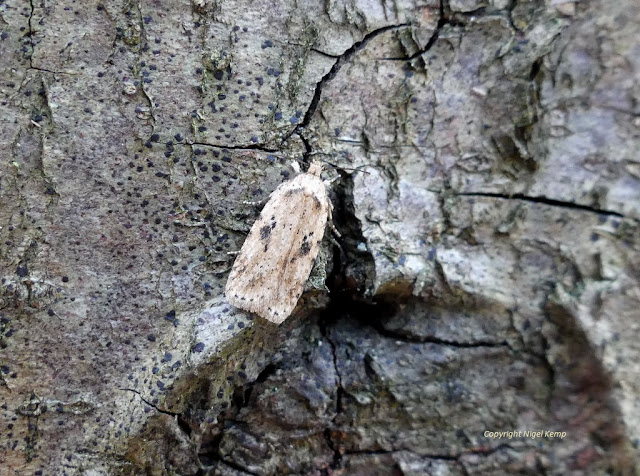


Agonopterix ocellana


Elephant Hawkmoth (Deilephila elpenor) (pupa)

This pupa was found laying on a pavement and had clearly been dislodged from its winter quarters in a nearby flower-bed by the scratchings of a cat or dog.


Peacock (Aglais io) (hibernating)

With its rich maroon ground colour and with each wing bearing a metallic eye, I think that the Peacock is arguably our most beautiful butterfly in Britain. It is one of a few species in the UK that hibernates as an adult and the almost black underside markings are perfect camouflage for hibernating in dark corners. I found this one in my garage on Christmas Eve.


Wednesday, 24 November 2021

Autumn Moth Collection

 As autumn progresses towards winter, the moth trap catches have become greatly reduced. There will still be a few species to come that are winter specialists and so I may yet put the trap out again if we are blessed with a few mild nights during the coming months.

Here is a selection of autumn species that I have attracted to the garden over the last couple of months, mainly common residents and occasional migrants. 

The first four images are of species that were recorded in my garden for the first time.


Scarce Bordered Straw (Helicoverpa armigera)


Boxworm (Cydalima perspectalis)


Tree-lichen Beauty (Cryphia algae)


Cryptic Fern (Horisme radicana)


Centre-barred Sallow (Atethmia centrago)


Green-brindled Crescent (Allophyes oxyacanthae)


Oak Nycteoline (Nycteola revayana)


Black Rustic (Aporophyla nigra)


Chestnut (Conistra vaccinii)


Delicate (Mythimna vitellina)


L-album Wainscot (Mythimna l-album)


Red-green Carpet (Chloroclysta siterata)


Sprawler (Asteroscopus sphinx)


Feathered Thorn (Colotois pennaria)


Palpita vitrealis


November Moth (Epirrita dilutata


Sunday, 14 November 2021

Devil's Fingers

 Devil's Fingers (Clathrus archeri), also known as the Octopus Stinkhorn, is a very striking fungus. The species was an accidental import from Australasia during the First World War and is still a rare find in Britain.

David, Bob and I have met up a few times over the last couple of years to search for specimens in locations where it is known to occur but it has proved to be a difficult species to find.

After another search earlier this month, Bob and I were on the point of calling it a day when David calmly announced that he had found one.


Devil's Fingers (Clathrus archeri)


The next day, I returned to the site to see whether the "tentacles" had opened out into a classic star formation but alas it had been attacked by slugs overnight.


Saturday, 30 October 2021

On the Caterpillar Trail

 As the season comes to an end and butterfly and dragonfly numbers decline, my attention turns to seeking out caterpillars. 

The months of September and October are a good time to look for larvae and once you get your eye in, they are pretty easy to find.

 At this time of year, many larvae of moth and sawfly species will be feeding up for either pupation or hibernation.


Scalloped Hook-tip (Falcaria lacertinaria) (larva on birch)


Birch Mocha (Cyclophora albipunctata) (larva on birch)

(note silken thread that larva uses to maintain position)


Knot Grass (Acronicta rumicis) (larvae on bramble and birch)


Drinker (Euthrix potatoria

(young larva basking on bramble prior to hibernation)


Peach Blossom (Thyatira batis)

 (pale and dark form larvae on bramble)


Buff Ermine (Spilosoma luteum) (larva on willow)


Nematus latipes (Sawfly sp.) (larvae on birch)


Tuesday, 12 October 2021

A Collection of Adders

 The Adder (Vipera berus) will be heading into hibernation during the coming weeks but they can still be seen sunning themselves on warm autumn days.

Males generally have the more contrasting markings. The zig-zag marking along its back is normally black with a paler ground colour to the rest of the body.

Females are generally of a more reddish-brown colour.

In some populations, melanistic Adders can be quite common.


Adder (Vipera berus)


Friday, 1 October 2021

Early Autumn on Pevensey Levels

 My spring and summer walks on Pevensey Levels this year were more often than not blighted by cool and blustery weather. By late September however, I was able to enjoy some walks in warm sunshine and still conditions.

Such weather conditions provide a better opportunity to find Fen Raft Spiders (Dolomedes plantarius) basking out in the open.

There are also other things of interest to be found along the field edges and ditch margins  


Fen Raft Spider (Dolomedes plantarius) (female with egg sac) 


Peacock (Aglais io) (larvae on common nettle) 

The Peacock is normally a single brooded butterfly. Its larvae are usually found in May and June but in recent years, a second brood has become an increasingly regular occurrence.


I found  this colony of larvae on 21st. September.


By 25th. September the final instar larvae had dispersed and should produce an emergence of adults during the latter half of October.


Reed Dagger (Simyra albovenosa) (larva on reed)

The Reed Dagger is a nationally scarce moth found in wetland habitats in the south-east of England.

This larva was spotted by my daughter as we walked along the ditch margins on 20th. September and it is nice to know that this species is breeding on Pevensey Levels.


Sunday, 26 September 2021

Wasp Spider

 I first came across a female Wasp Spider (Argiope bruennichi) on the Isle of Wight, back in the early 1990's. In those days it was a rare find but nowadays it is a common species in southern England.

There is no mistaking this stunning creature for any other species of spider and whilst many of us shudder at the sight of a house spider galloping across the living room carpet, I have no qualms about getting close to this beauty.

Not only is the spider itself easily identified but its web is also very distinctive, usually bearing one or more zig-zag features in its structure.

The peak of the Wasp Spiders breeding season occurs during August when sometimes many females can be found sitting in the middle of their webs, low down in long grass.


Wasp Spider (Argiope bruennichi)

(female)


It is often said that every picture tells a story and that is certainly true of the following image. 

Approaching the female Wasp Spider is rather hazardous for the much smaller male. The female regularly eats the male either after or during mating and he must choose his moment carefully if he is to escape after a successful mating. That moment is generally just after the female has shed her old skin and before her new skin and mouthparts have hardened.

In the following image, the shed skin of the female can be seen in the web above her. Above that, a male spider sits at the periphery of the web contemplating his approach.

On the left of the female are the remains of another spider that she has devoured. This was either an unsuccessful male or another species of spider that wandered too close.


This male awaits his chance to approach a female on another web.


This female is feeding on a grasshopper (their main prey) that has leapt into her web.


The flask shaped egg sac of the Wasp Spider can be quite variable in size but the following image is of the largest one I have ever found, measuring 4cms. in length.