Thursday, 27 February 2020

Breeding Toads

Despite having to scrape the windscreen yesterday morning, it was a bright and breezy day and I set off for a walk on the downs to check one of my favourite dewponds for any signs of toad activity. 

Usually by the first week of March, this pond is heaving with breeding toads but on my arrival it looked very much like the main event was nearly over. 

This should really be no surprise, as the winter has been unusually mild.

 I normally expect to see dozens of breeding toads but I only saw about five pairs. However, the pond side was absolutely clogged with spawn, signalling that many pairs had already been and gone.


Common Toad (Bufo bufo)


During the breeding season, the highly charged males will fight each other off in a frenzied attempt to grasp a female and she can disappear into a ball of writhing males. Occasionally, sadly, females are accidentally drowned. I think that this is what has happened to the female in the following image. There were no signs of her having been predated upon.


Back on 5th February, Bob and I saw our first Red Admiral (Vanessa atalanta) of the year whilst we were walking on Ashdown Forest.

Essentially a migrant to our shores, this species has only relatively recently been able to survive the winter in Britain. It is a continuously breeding species and does not have the ability to hibernate. Many fly south in the Autumn but some overwinter as adults or larvae. Adult butterflies need to roost during inclement weather and they must go in search of food during sunny and mild spells in order to stay alive.

The heathland of Ashdown Forest provides plenty of thick insulating layers of dead bracken in which to roost and plenty of winter-flowering gorse to nectar upon.


Red Admiral (Vanessa atalanta)


Wednesday, 5 February 2020

Emperor

To the best of my knowledge, there are only three resident insects occurring in Britain which have the name Emperor in their title.

When a species bears such an epithet, you can be assured that you will be looking at a striking and magnificent creature.

Whilst I impatiently await the start of Spring, here are some images of those three Emperors.


Emperor Moth (Saturnia pavonia)

Female.


Mature larva on heather.


Male.


Emperor Dragonfly (Anax imperator)

Male.


Female.


Ovipositing female.


Nymph.


Exuviae.


Purple Emperor (Apatura iris)

Male.


Female.


Saturday, 18 January 2020

Winter Stinkhorn

So far, our winter has been very mild and the new season has started in much the same vein as the old season ended.

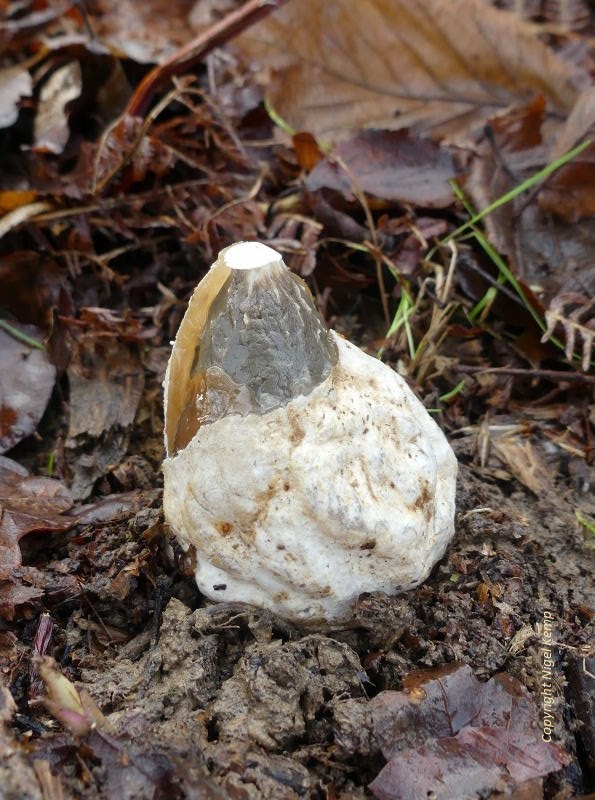
 On the 15th January, during another walk in the woods, I came across a further unseasonal appearance of a Common Stinkhorn (Phallus impudicus) emerging through the leaf litter.

The following images were taken on three consecutive days.


Common Stinkhorn (Phallus impudicus)


1st Day


2nd Day


3rd Day


Tuesday, 31 December 2019

An Unseasonal Appearance

Walking through the woods on 27th December, I was amazed to find a Common Stinkhorn (Phallus impudicus) standing at the edge of the trees. According to my references, its fruiting season is usually from June to October. Of course, if the weather conditions are right, then any unseasonal appearance can be triggered. At peak season, the spores can be distributed by flies within hours but in December, with fewer flies about, this task may not be completed before the slugs have feasted on the stem.

The Yellow Stagshorn (Calocera viscosa) can be found throughout the year.


Common Stinkhorn (Phallus impudicus)


Yellow Stagshorn (Calocera viscosa)

Tuesday, 24 December 2019

From the 2019 Cutting Room Floor

As usual, here are a few images from 2019 that didn't quite make the final cut or those that I just didn't get round to posting.

During the first week of September, we travelled to Avignon in France with friends. The weather was lovely but the Mistral was pretty active for much of our stay and not very conducive to insect photography. However, I did find some insect life in a few sheltered corners.


Mallow Skipper (Carcharodus alceae)


Cicada sp. (exuvia)


Yellow-legged Hornet (Vespa velutina)


As I walked along a farm track on Pevensey Levels in July, I saw a Painted lady butterfly on the ground about 20 yards ahead of me. Through the binoculars, it looked as though it was dead and had been trodden into the muddy track but as I got closer it was clear that it was very much alive but missing half of its wing area. After I took a couple of images, it took flight every bit as powerfully as if it was just a few days old.


Painted Lady (Vanessa cardui)


Also in July, I was sitting in a friends garden in Berkshire when my attention was drawn to some Ringed-necked Parakeet activity atop a nearby tree.
 I think a male feeding its offspring.


Ring-necked Parakeets (Psittacula krameri)


A few days later, I was with the same friends enjoying a trip up the River Dart from Dartmouth to Totnes in Devon. Several miles inland I managed to grab a quick shot of this Grey Seal in the few seconds that it remained above water.


Grey Seal (Halichoerus grypus)


Still in July and visiting one of my local National Trust properties, I spotted this young Pike (only about 9 inches long) as I peered into a moat from a footbridge.


Pike (Esox lucius)


Back in February, I was peering up at the east window of York Minster when my friend spotted this Peregrine preening itself high up on the arch of the window.


Peregrine Falcon (Falco peregrinus)


Tuesday, 10 December 2019

Squirrel Encounter

Yesterday was another sunny day and another opportunity for a walk in the woods for some sunshine therapy. 

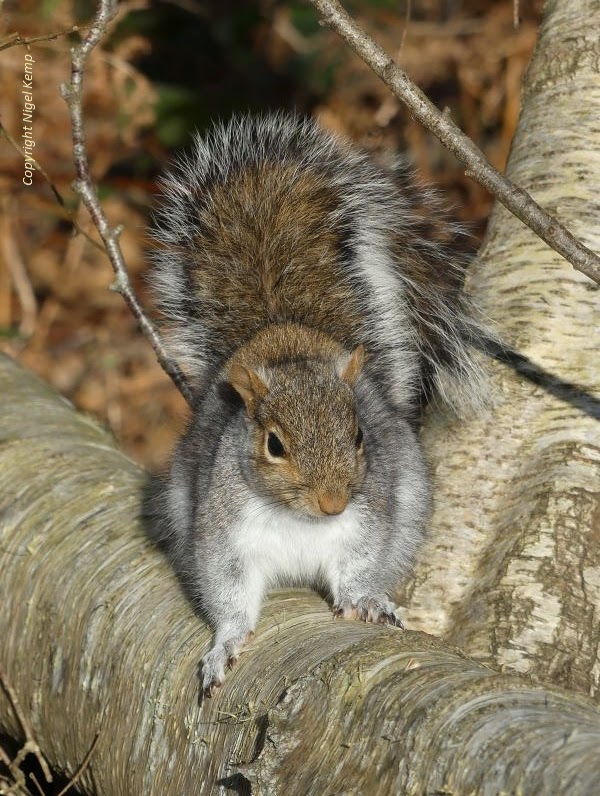
As I walked along a woodland ride through birch coppice, movement amongst the dead bracken caught my eye and I saw that a Grey Squirrel (Sciurus carolinensis) was busy sifting through the leaf litter. I froze and slowly got my camera from its case. There was no clear view through the undergrowth but with several fallen birch trees nearby, I decided that patience was the best option.


Grey Squirrel (Sciurus carolinensis) 


Common Earthball (Scleroderma citrinum)


Thursday, 5 December 2019

Late Autumn Sunshine

At this time of year I like to make use of any sunny days that come along as there is always a chance of seeing a late season insect fly past.

 The grey, damp days of winter will soon predominate.

The 29th November was one such day and I came across a Peacock (Inachis io) that had been tempted out of hibernation to bask in the sunshine under a clear blue sky.


Peacock (Inachis io)


The following images are of a small group of Inkcap fungi taken on two consecutive days. On checking my books, the description and habitat leads me to think that they are;

Coprinus silvaticus