Saturday, 18 January 2020

Winter Stinkhorn

So far, our winter has been very mild and the new season has started in much the same vein as the old season ended.

 On the 15th January, during another walk in the woods, I came across a further unseasonal appearance of a Common Stinkhorn (Phallus impudicus) emerging through the leaf litter.

The following images were taken on three consecutive days.


Common Stinkhorn (Phallus impudicus)


1st Day


2nd Day


3rd Day


Tuesday, 31 December 2019

An Unseasonal Appearance

Walking through the woods on 27th December, I was amazed to find a Common Stinkhorn (Phallus impudicus) standing at the edge of the trees. According to my references, its fruiting season is usually from June to October. Of course, if the weather conditions are right, then any unseasonal appearance can be triggered. At peak season, the spores can be distributed by flies within hours but in December, with fewer flies about, this task may not be completed before the slugs have feasted on the stem.

The Yellow Stagshorn (Calocera viscosa) can be found throughout the year.


Common Stinkhorn (Phallus impudicus)


Yellow Stagshorn (Calocera viscosa)

Tuesday, 24 December 2019

From the 2019 Cutting Room Floor

As usual, here are a few images from 2019 that didn't quite make the final cut or those that I just didn't get round to posting.

During the first week of September, we travelled to Avignon in France with friends. The weather was lovely but the Mistral was pretty active for much of our stay and not very conducive to insect photography. However, I did find some insect life in a few sheltered corners.


Mallow Skipper (Carcharodus alceae)


Cicada sp. (exuvia)


Yellow-legged Hornet (Vespa velutina)


As I walked along a farm track on Pevensey Levels in July, I saw a Painted lady butterfly on the ground about 20 yards ahead of me. Through the binoculars, it looked as though it was dead and had been trodden into the muddy track but as I got closer it was clear that it was very much alive but missing half of its wing area. After I took a couple of images, it took flight every bit as powerfully as if it was just a few days old.


Painted Lady (Vanessa cardui)


Also in July, I was sitting in a friends garden in Berkshire when my attention was drawn to some Ringed-necked Parakeet activity atop a nearby tree.
 I think a male feeding its offspring.


Ring-necked Parakeets (Psittacula krameri)


A few days later, I was with the same friends enjoying a trip up the River Dart from Dartmouth to Totnes in Devon. Several miles inland I managed to grab a quick shot of this Grey Seal in the few seconds that it remained above water.


Grey Seal (Halichoerus grypus)


Still in July and visiting one of my local National Trust properties, I spotted this young Pike (only about 9 inches long) as I peered into a moat from a footbridge.


Pike (Esox lucius)


Back in February, I was peering up at the east window of York Minster when my friend spotted this Peregrine preening itself high up on the arch of the window.


Peregrine Falcon (Falco peregrinus)


Tuesday, 10 December 2019

Squirrel Encounter

Yesterday was another sunny day and another opportunity for a walk in the woods for some sunshine therapy. 

As I walked along a woodland ride through birch coppice, movement amongst the dead bracken caught my eye and I saw that a Grey Squirrel (Sciurus carolinensis) was busy sifting through the leaf litter. I froze and slowly got my camera from its case. There was no clear view through the undergrowth but with several fallen birch trees nearby, I decided that patience was the best option.


Grey Squirrel (Sciurus carolinensis) 


Common Earthball (Scleroderma citrinum)


Thursday, 5 December 2019

Late Autumn Sunshine

At this time of year I like to make use of any sunny days that come along as there is always a chance of seeing a late season insect fly past.

 The grey, damp days of winter will soon predominate.

The 29th November was one such day and I came across a Peacock (Inachis io) that had been tempted out of hibernation to bask in the sunshine under a clear blue sky.


Peacock (Inachis io)


The following images are of a small group of Inkcap fungi taken on two consecutive days. On checking my books, the description and habitat leads me to think that they are;

Coprinus silvaticus


Monday, 25 November 2019

Fungi Foray

I have never really taken much of a close interest in Fungi over the years and have only ever been able to positively identify the obvious few.

 Now that the insect world has pretty much bedded down for the winter, I have started to take more notice of the wonderful structures that many fungi are.

 I am never going to be an expert Mycologist but I now find that I want to put names to some of the fungi that I come across. I am more confident at naming some than others and I have quickly realised that just taking photographs in the field and trying to identify them from books at home is fraught with confusion.


Orange Peel Fungus (Aleuria aurantia)


Tawny Grisette (Amanita fulva)


I have been going round in circles trying to name this next species but a bruise test on the pore surface left a brown thumb mark. I think it might be a Penny Bun (Boletus edulis)


Wood Blewit (Lepista nuda)


Yellow Stagshorn (Calocera viscosa)


White Coral Fungus (Clavulina cristata)


Candle-snuff Fungus (Xylaria hypoxylon)


Sunday, 10 November 2019

A Woodland Floor in Autumn

Now that we are into late Autumn, a walk in my local woods has become rather soggy underfoot and the sight and smell of decay is evident through the understorey.

Although there is still a chance of seeing late season insects on any remaining sunny days, new life is emerging through the damp leaf litter of the woodland floor.


Minotaur Beetle (Typhaeus typhoeus) (male) 


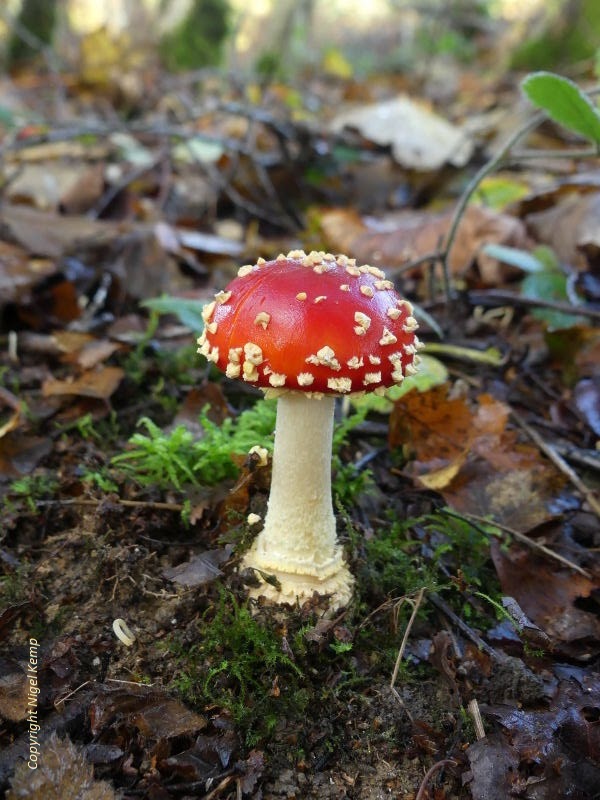
Fly Agaric (Amanita muscaria)

I photographed this specimen on three consecutive days.


The Blusher (Amanita rubescens)


False Death Cap (Amanita citrina)


Stump Puffball (Lycoperdon pyriforme)