Saturday, 10 August 2019

Ensuring the Next Generation

The instinct to survive predominates in the world of insects and spiders but the instinct to reproduce is very strong. The sole mission of male butterflies and dragonflies is to search for females with which to mate and very often, female butterflies are found and mated with very soon after they have emerged from the pupa.

Walking around Pevensey Levels in recent weeks, the reproductive cycle has been evident everywhere.


Small Copper (Lycaena phlaeas) (mating)

The female is the lower of the pair and the dusting on her hind wings is probably grass pollen.


Ruddy Darter (Sympetrum sanguineum) (mating)


Fen Raft Spider (Dolomedes plantarius) (female with egg sac)

The female is an extremely attentive mother and will carry the egg sac everywhere. When the eggs start to hatch, she will construct a nursery web and remain with her offspring until they disperse naturally.


Wednesday, 17 July 2019

Purple Hairstreak and Life Amongst the Bracken Fronds

Although the Purple Hairstreak (Quercusia quercus) rightly has a reputation for being difficult to see at close quarters, it is a regular visitor to the woodland floor in the early morning. As the sun rises, the adults are tempted down from the canopy to take moisture and bask on bramble leaves and bracken fronds.

As I move quietly and slowly through the bracken beds, I come across many other early morning baskers.


Purple Hairstreak (Quercusia quercus) (female)


Purple Hairstreak (Q. quercus) (female ab. flavimaculatus)


Silver-washed Fritillary (Argynnis paphia) (males)


Common Lizard (Lacerta vivipara) (pregnant female)


Red-eyed Damselfly (Erythromma najas) (teneral female)


Strangalia quadrifasciata (Longhorn sp.)


Oak Jewel Beetle (Agrilus biguttatus)


Wednesday, 10 July 2019

Southern Damselfly

Last week, I headed for the New Forest in Hampshire to spend a day in search of the Southern Damselfly (Coenagrion mercuriale).

 This is one of our most endangered species of damselfly and it has very specific habitat requirements. Colonies can only be found along shallow, slow moving heathland streams with clear water usually running over a bed of gravel and within a warm microclimate. 

 As with all 'blue' damselfly species, the diagnostic identifying features can usually be found within the markings of the abdomen.


Southern Damselfly (Coenagrion mercuriale)

(males)


(female)


(pair in tandem)


Saturday, 29 June 2019

Duke of Burgundy and Orchids in Kent

Back in early May, Bob and I indulged in our annual day out in Kent to visit some special sites. We always start off at Denge Wood to see the Duke of Burgundy (Hamearis lucina) but these semi-ancient woods are also home to other rare insects.

Kent is also a county in which to seek out some of our rarer orchids.

Here are some images of the day.


Duke of Burgundy (Hamearis lucina) (female)


Fly Orchid (Ophrys insectifera) (var. ochroleuca)

The typical form has maroon coloured flowers.


Herb Paris (Paris quadrifolia)


Man Orchid (Orchis anthropophora)


Monkey Orchid (Orchis simia)


More recently and closer to home, I visited the colony of Spiked Rampion that grows just a few miles from my home. This is a very rare and endangered plant and only occurs at a handful of sites in East Sussex. It is found nowhere else in the UK.

Spiked Rampion (Phyteuma spicatum)


Wednesday, 26 June 2019

valezina

Yesterday, the early morning weather was overcast, still and humid. I try not to waste days like this and I set out to a local Wealden wood to see what was lazing around on the bramble leaves and bracken fronds.

I was focusing on looking for freshly emerged Purple Hairstreaks in the undergrowth when a mating pair of Silver-washed Fritillaries (Argynnis paphia) flew across in front of me and landed nearby. It was immediately clear that the female of the pair was form valezina, where the usual orange ground colour is replaced by olive-green. This form does not occur in the male paphia and accounts for about 10% of the female population.


Silver-washed Fritillary (Argynnis paphia) (mating, female form valezina)


Emperor Dragonfly (Anax imperator) (female)


Ringlet (Aphantopus hyperantus) (male)


Thursday, 6 June 2019

Small Pearl-bordered Fritillary

The Sussex race of Small Pearl-bordered Fritillary (Boloria selene) had been in decline for several years before it finally disappeared from its one remaining site in East Sussex in 2013. In fact, to my knowledge, it was the only remaining colony in south-east England. Habitat degradation is always high on the list of causes in such cases but as a butterfly of damp woodland rides, it has probably also become a victim of a drying climate in south-east England.

Two years ago, selene was reintroduced to its former haunt and it is wonderful to see this lovely little fritillary once again flying in East Sussex. A true measure of success with any reintroduction may be several years down the line when the population continues to be self sustaining and able to establish satellite colonies away from the introduction site, but so far so good.

Hats off to everyone who has been involved in the project.


Small Pearl-bordered Fritillary (Boloria selene)

(females)


(males)


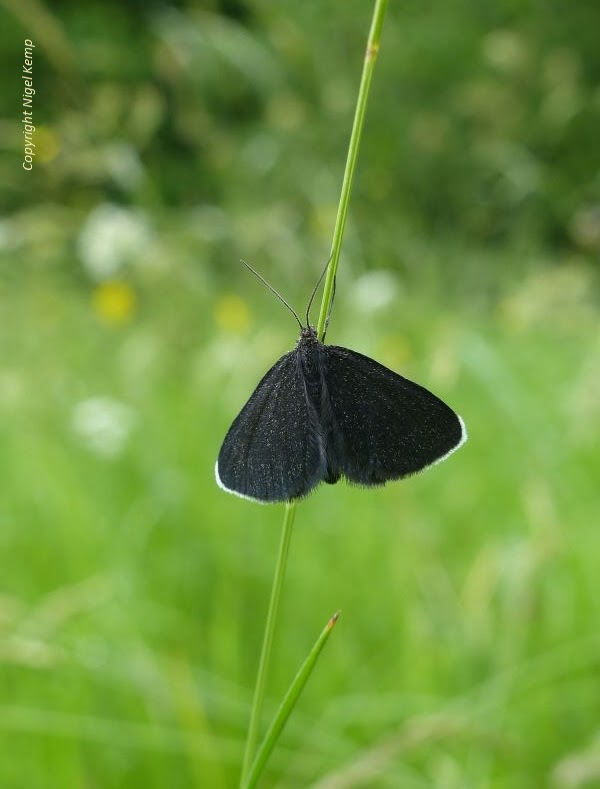
The Chimney Sweeper moth is another rare species in East Sussex and only occurs in discrete colonies on a handful of sites, where its foodplant grows in unimproved Wealden meadows.

Chimney Sweeper (Odezia atrata)


Saturday, 1 June 2019

Hairy Dragonfly

The Hairy Dragonfly (Brachytron pratense) is usually the first species of dragonfly to be seen on the wing each Spring and they are now approaching their population peak on Pevensey Levels.


Hairy Dragonfly (Brachytron pratense)

Freshly emerged female


A basking female


Freshly emerged male on the point of taking its first flight


Variable Damselfly (Coenagrion pulchellum) (mating)


Common Blue (Polyommatus icarus) (female ab.supracaerulea)

This all-blue aberration of the female icarus was once a rare find but in recent years it has become much more regular in its occurrence. In my youth back in the 1960's, the most common form of the female icarus was brown with variable amounts of blue pigment only in the basal area of the wings, a form that is much more noteworthy nowadays. I presume the cause of such a change is environmental, perhaps due to a warming and drying climate?