Friday, 4 May 2018

Life in the Water Channels

I don't normally see the Fen Raft Spider (Dolomedes plantarius) on Pevensey Levels before the end of May but I saw my first one of the year nearly two weeks ago. That individual was too far away to photograph but yesterday I came across a handsome female resting amongst the ditch-side foliage and looking like she had recently undergone a skin-shed.
 
 
Fen Raft Spider (Dolomedes plantarius) (female)


The Large Red Damselfly (Pyrrhosoma nymphula) has been on the wing for the last two weeks and numbers are steadily increasing but yesterday I saw my first Variable Damselfly (Coenagrion pulchellum) of the year, with half a dozen seen on the wing.
 
 
Large Red Damselfly (Pyrrhosoma nymphula) (teneral female)


Variable Damselfly (Coenagrion pulchellum) (female)


Drinker Moth (Euthrix potatoria) (mid-instar larva feeding on grass sp.)

Friday, 27 April 2018

The Green Hairstreak

Over the last couple of days I have been watching the antics of the Green Hairstreak (Callophrys rubi) along the sunny edge of a Wealden wood. It is the earliest of the British Hairstreaks to be seen on the wing (the others being summer emergents) and it is probably the easiest of them all to approach and observe at low level. I have found several mating pairs over the years but yesterday I was able to observe the brief courtship and coupling as it happened.
 
 
Green Hairstreak (Callophrys rubi) (mating)
 
(the female is the fresher and slightly darker looking individual)


Green Hairstreak (C.rubi) (males) 
 
(this male is showing signs of a bird strike, probably by a warbler that has tried to catch it in flight)


(this male is showing how this species typically holds its wings at a perpendicular angle to the sun's rays)


The Grey Birch moth (Aethalura punctulata) is not a species that comes to my garden light-trap. Established birch woodland is its preferred habitat and I often see it flying during the day when I'm working in the woods. 
 
 
Grey Birch (Aethalura punctulata) 


Yesterday, I came across this young Toad (Bufo bufo) on the woodland floor and looking for shelter from the sun. It was just 2.5 cms. long and was probably a tadpole from spring 2017. Toads do not reach maturity until they are 4 or 5 years old and can live for 30 or 40 years.
 
 
Common Toad (Bufo bufo) (juvenile)


Green-veined White (Pieris napi) (male)


Common Frog (Rana temporaria)

Friday, 20 April 2018

Water Stick-insect

What a difference a few days makes. After walking around last week looking for my first Spring emerging butterflies of the year in temperatures that were just getting into double figures; a week later and the temperature has soared into the high 20's. Since the weekend, numbers of emerging Small Whites and Orange-tips have accelerated but it is far too hot to chase them around for a photograph just yet.
 
Earlier this week I decided to check one of my favourite wealden ponds for signs of emerging damselflies but on this occasion I was rewarded with my first ever sighting of a Water Stick-insect (Ranatra linearis) climbing out of the water to bask on the pondside vegetation.
 
This underwater predator spends much of its time motionless amongst underwater foliage and is well adapted to its lifestyle. It has an air tube that extends from its tail and its front legs end in curved claws that are used to catch tadpoles and small fish.
 
 
Water Stick-insect (Ranatra linearis)


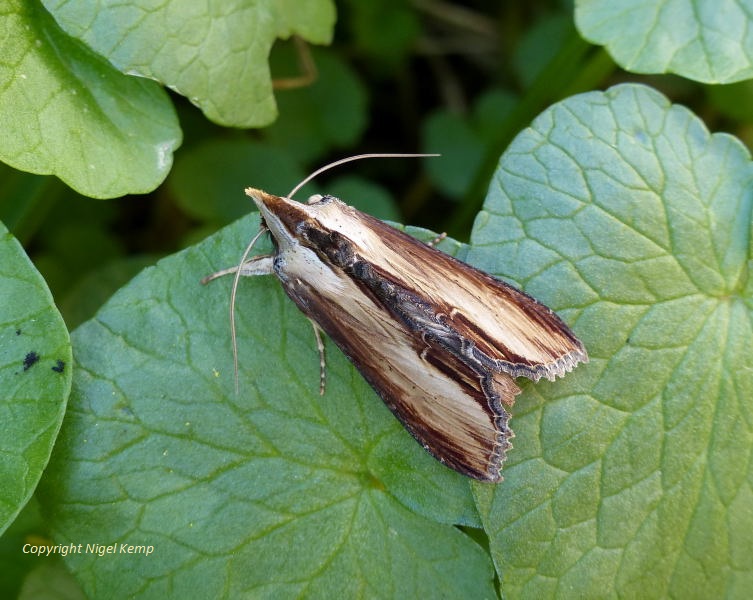
My garden moth-trap is now starting to attract species other than Quakers and Hebrew Characters and this morning's catch included a freshly emerged Mullein and also my second Brindled Beauty of the year.
 
 
Mullein (Shargacucullia verbasci)


Brindled Beauty (Lycia hirtaria)


Saturday, 17 March 2018

More Spring Awakenings

One of my favourite pursuits during the early days of Spring is to watch for Frogs and Toads returning to their breeding pools. I have a particular fondness for the Common Toad (Bufo bufo) whose antics are a delight to watch as the males battle for females and paired couples venture off into the pond foliage to lay their strings of spawn.
 
I found this pair in mating clasp and enjoying the afternoon sunshine in a wealden pond this week.
 
 
Common Toad (Bufo bufo)


On Pevensey Levels this week, I came across a freshly emerged Orange Underwing moth (Archiearis parthenias) on a log, drying its wings. These day flying moths invariably take off from the ground before you spot them and it was nice to see just how beautifully marked their underwings are. 
 
  
Orange Underwing (Archiearis parthenias)


I later found a fresh Minotaur Beetle (Typhaeus thyphoeus) scuttling through the leaf litter. The male of this species has three horns projecting from the front of the thorax.
 
 
Minotaur Beetle (Typhaeus typhoeus) (male)


Friday, 9 March 2018

Butterflies at Wisley 2018

The "Butterflies in the Glasshouse" exhibition is held annually at RHS Wisley during January & February. I find this event an enjoyable way to spend a cold and dull winter's day trying to improve my basic knowledge of butterflies from around the world.
 
Here is a selection of images from this year.
 
 
Batwing (Atrophaneura semperi)
 
(The first two images are males, the next two are females)


Ruby-spotted Swallowtail (Papilio anchisiades)


Giant Swallowtail (Papilio cresphontes)


Mocker Swallowtail (Papilio dardanus)
 
(The first two images are males, the next is female)


Giant Orange Tip (Hebomoia glaucippe)


Glasswing (Greta oto)


Postman (Heliconius melpomene)


White Morpho (Morpho polyphemus)


Tiger Leafwing (Consul fabius)


Autumn Leafwing (Doleschallia bisaltide)


Blue Wave (Myscelia cyaniris)


Blue-frosted Banner (Catonephele numilia)
 
(male and female)


Clipper (Parthenos sylvia sylvia)


Some species readily breed within the butterfly house environment and their larvae can sometimes be spotted feeding on the tropical foliage.
 
Pale Owl (Caligo memnon) (early instar larvae on banana leaf)  


Pale Owl (C.memnon) (mature larva)


Blue Morpho (Morpho peleides) (larva)