Showing posts with label Duke of Burgundy. Show all posts

Friday, 9 January 2026

Coppers and Metalmarks in Sussex

 This winter, I am continuing the theme of Butterflies in Sussex, that I started last winter.

Of the two species covered in this post, one is a common member of the Lycaenidae family and the other is the only member of the Riodinidae family to occur in Britain.


Small Copper (Lycaena phlaeas)

This species is widespread and fairly common in Sussex and can be found in a range of habitats. It is probably most at home on downland but is also found on heathland, along woodland rides and field edges. It generally has three broods a year and I find that it becomes more numerous with each brood.


Male


Female


Female (form caeruleopunctata)

A predatory Crab Spider (Misumena vatia) awaits prey on the fleabane head on the left.


Mating pair


This species is subject to great variation and has many named aberrations.
Here are a couple of examples.


Male (ab. schmidtii) 


Female (ab. extensa)


Duke of Burgundy (Hamearis lucina)

This species is the only member of the Riodinidae family (Metalmarks) to occur in Britain and is one of our rarest and most vulnerable resident species.

 In Sussex, it was on the brink of extinction at the turn of the century but due to targeted habitat management, its numbers have increased very well and its populations in West Sussex are stable. It occurs in discreet colonies on north-facing slopes.


Males


Females


Mating pair

The female (left) has 3 pairs of walking legs and the male has only two pairs. 


Female, with pigment deformity in right forewing.


Tuesday, 18 January 2022

Kent Foray in May 2021

 Most years, Bob and I go on a day-trip into Kent to have a wander around some semi-ancient woodlands that abound with natural gems.

 On 20th May 2021, we set off from East Sussex in dull, cool conditions but were hopeful that a few spells of sunshine would assist us during the day. However, the weather conditions remained overcast and chilly all day.

It was no surprise that we had the sites to ourselves for the day but all was not lost.


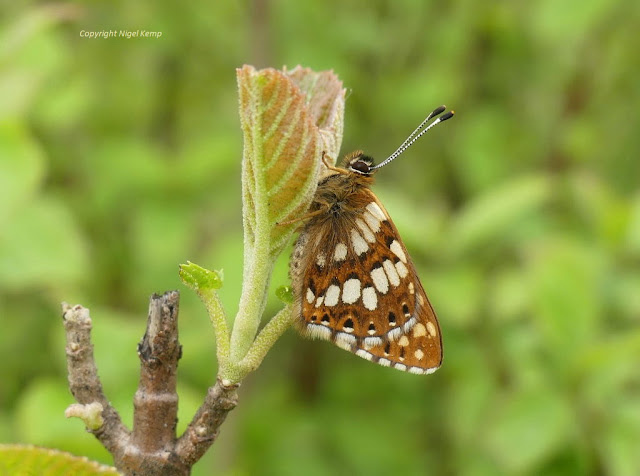
Duke of Burgundy (Hamearis lucina) (male) 

(freshly emerged and still drying its wings)


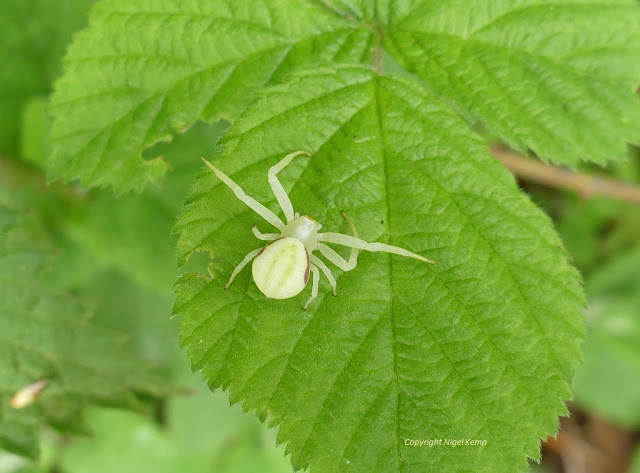
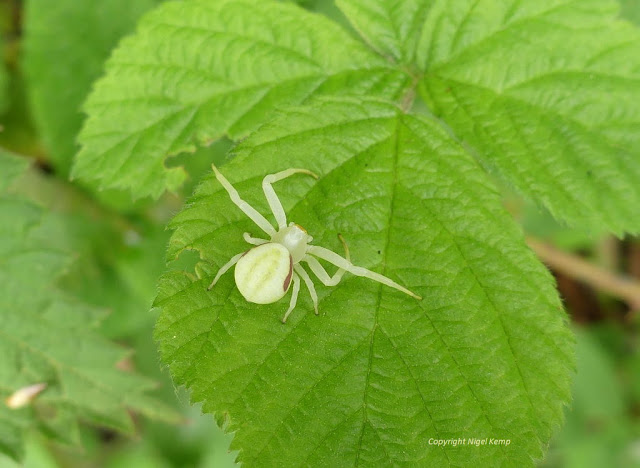
Misumena vatia (Crab Spider sp.)


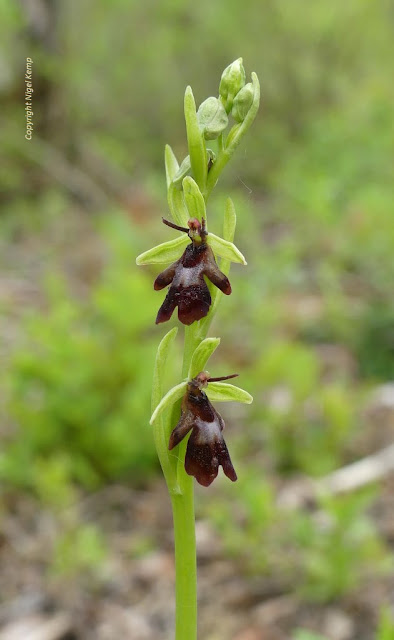
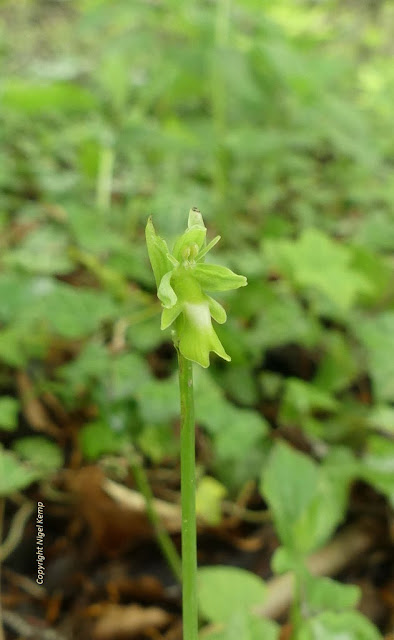
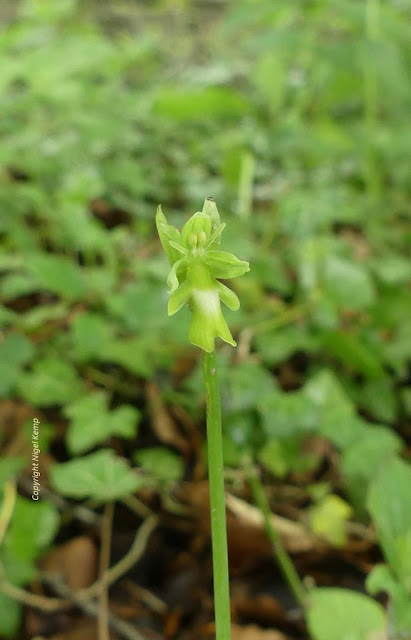
Fly Orchid (Ophrys insectifera)

(typical form)


var. ochroleuca


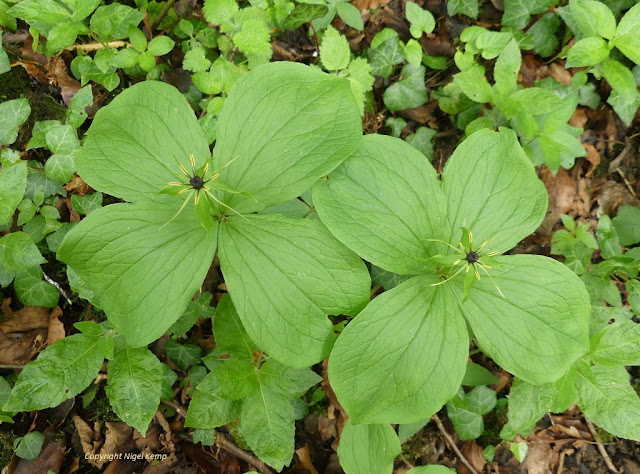
Herb Paris (Paris quadrifolia)


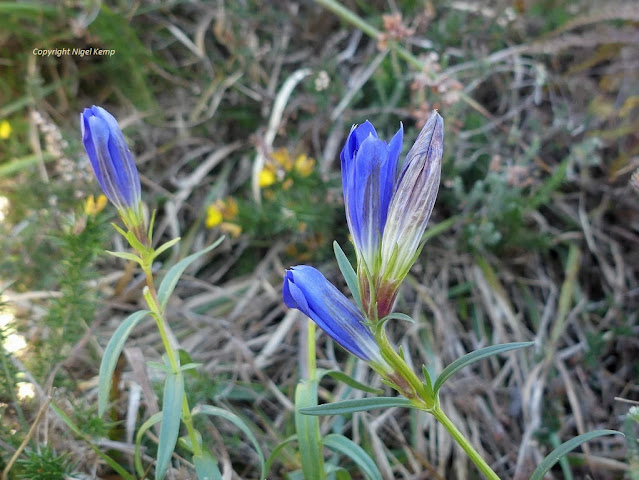
Back in East Sussex during the Autumn, Bob, David and I came across this rather lovely plant, as we searched for the elusive Devil's Fingers Fungus.


Marsh Gentian (Gentiana pneumonanthe)


Saturday, 29 June 2019

Duke of Burgundy and Orchids in Kent

Back in early May, Bob and I indulged in our annual day out in Kent to visit some special sites. We always start off at Denge Wood to see the Duke of Burgundy (Hamearis lucina) but these semi-ancient woods are also home to other rare insects.

Kent is also a county in which to seek out some of our rarer orchids.

Here are some images of the day.


Duke of Burgundy (Hamearis lucina) (female)


Fly Orchid (Ophrys insectifera) (var. ochroleuca)

The typical form has maroon coloured flowers.


Herb Paris (Paris quadrifolia)


Man Orchid (Orchis anthropophora)


Monkey Orchid (Orchis simia)


More recently and closer to home, I visited the colony of Spiked Rampion that grows just a few miles from my home. This is a very rare and endangered plant and only occurs at a handful of sites in East Sussex. It is found nowhere else in the UK.

Spiked Rampion (Phyteuma spicatum)


Friday, 27 January 2017

Variation in Butterflies

Variation in butterflies is an interesting subject within the study of lepidoptera and there are a number of reasons for its occurrence. I am no scientist but broadly speaking, variation can occur as a result of the geographical isolation of populations which can lead to different sub-species and even new species evolving. Variation between the sexes (sexual dimorphism) and variation between different broods (seasonal dimorphism) occurs in many species. Variation (or aberrations) can also occur within a species as a result of genetic mutation or environmental influences during critical stages of the life cycle.

I have seen numerous variations over the years and here is a selection of photographs.

Although the occurrence of some variants can be manipulated through captive breeding, the following examples were found and photographed in the wild.


Clouded Yellow (Colias croceus) (female)
The standard form.


Clouded Yellow (C.croceus) (female, form helice)

This pale form only occurs in the female croceus and can account for about 10% of the female population.


Small Copper (Lycaena phlaeas) (female, form caeruleopunctata)

A regular form which displays a line of blue submarginal spots on the hindwings.


Small Copper (L.phlaeas) (male, ab. schmidtii)

This aberration is a genetic mutation caused by a recessive gene.


Common Blue (Polyommatus icarus) (male)

This species is sexually dimorphic.


Common Blue (P.icarus) (female)


Common Blue (P.icarus) (female, ab. albocincta)


Common Blue (P.icarus) (female, ab. supracaerulea)


Chalkhill Blue (Lysandra coridon) (male, ab. caeca)

All sub-marginal spotting is absent.


Chalkhill Blue (L.coridon) (female, ab. postobsoleta)

The female of this mating pair is showing much reduced sub-marginal spotting on the hindwing. 


Duke of Burgundy (Hamearis lucina) (female)

Not strictly regarded as an aberration, this specimen is displaying a pigment deformity in one wing.


White Admiral (Limenitis camilla) (female)


White Admiral (L.camilla) (ab. obliterae)

The reduced wing markings are caused by low temperatures during the pupal stage of the life cycle.


Small Tortoiseshell (Aglais urticae)


Small Tortoiseshell (A.urticae) (a transitional form of ab. semi-ichnusoides)

This aberration is caused by high temperatures during the pupal stage of the life cycle.


Comma (Polygonia c-album)


Comma (P.c-album) (ab. obscura)

The markings on the hind wings have become blotched and the borders are indistinct.


Wall (Lasiommata megera) (male)


Wall (L.megera) (male, ab. fascia)


Gatekeeper (Pyronia tithonus) (female)


Gatekeeper (P.tithonus) (female, ab. anticrasipuncta)

Many aberrations take the form of enlarged or reduced eye-spots.


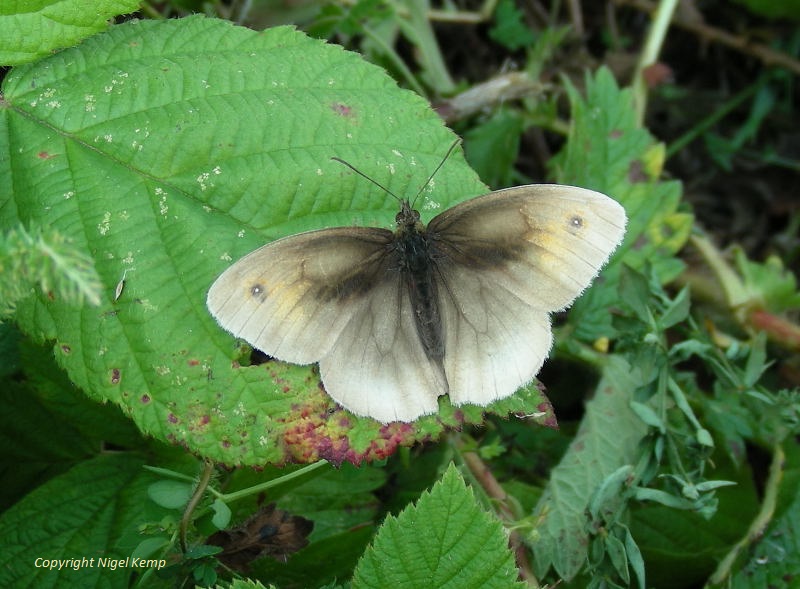
Meadow Brown (Maniola jurtina) (male, ab. pallidus)

The normally chocolate brown ground colour has been replaced by pale grey and is not to be confused with age related bleaching that often occurs in this species