Showing posts with label Common Frog. Show all posts

Wednesday, 2 April 2025

Along the Woodland Edge in March

 There were numerous sunny days during March but often accompanied by a cool easterly breeze. Sunny and sheltered corners in my local woods have seen multiple numbers of butterflies waking from hibernation. The Brimstone males have been too busy to stop for a photograph but the Commas and Peacocks have been more obliging.


Comma (Polygonia c-album)   


Peacock (Aglais io)


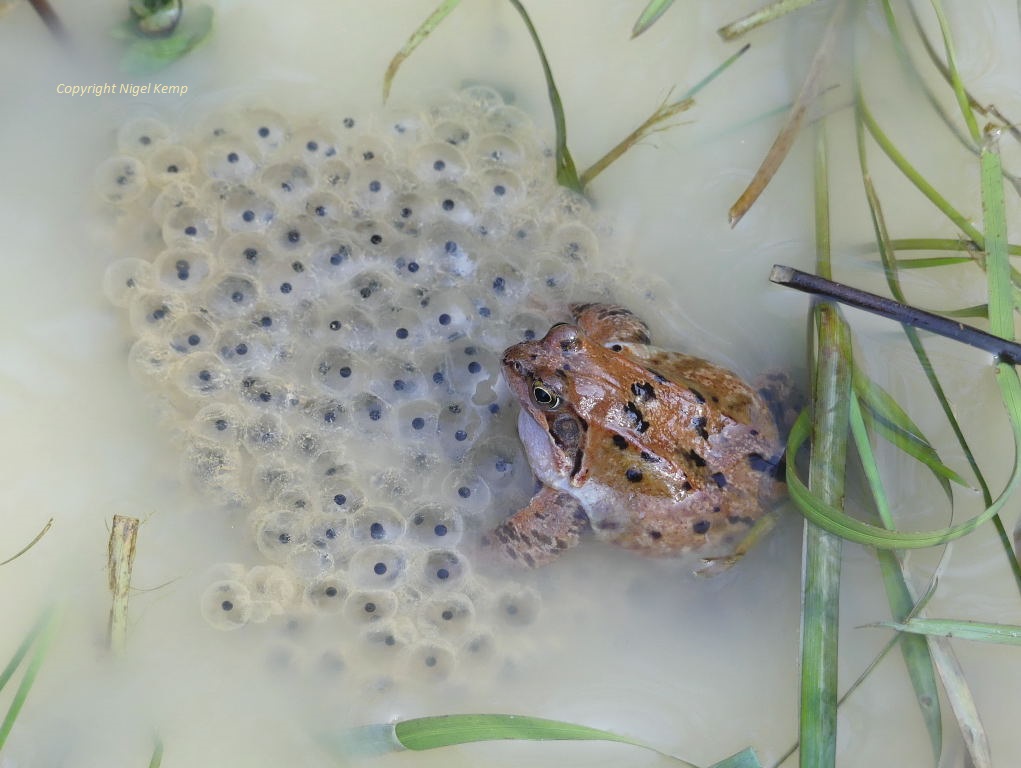
Common Frog (Rana temporaria)

Whilst walking along a woodland track, I heard the sound of a croaking frog and on checking the trackside ditch, I found a female spawning in a muddy pool. She was accompanied by a male.


Common Toad (Bufo bufo)

This male was at rest on the trackside verge.


Sunday, 16 March 2025

Toad Spectacle

 One of the great natural spectacles that I look forward to every spring is the return of toads to their breeding ponds. One of the best sites that I know is just a ten minute drive from home, where I can rely on watching the antics of at least a hundred toads. At this particular site, the toads arrive and depart in little over a week.

The following images were taken over a couple of days at the height of their activities.


Common Toad (Bufo bufo)

This female had probably been carrying these two males for some time and had not yet reached the millpond in which they breed. She had decided to have a rest in the middle of a footpath. The male in prime position eventually managed to eject the interloper.


These pairs of toads have successfully moved away from the general melee in order to spawn.


These males were basking in the occasional sunshine.


This turmoil of toads is where the main action takes place.  Every male is highly charged and is trying to push the other males away and burrow their way to the female in the centre. She will already have a suitor in prime position and if all goes well, they will manage to get away to spawn. Occasionally, sadly, a female can be accidentally drowned if she cannot extricate herself. I came back the following day and there was no sign of any tragedies having occurred.


Now and then you may witness a strange pairing. In the following image, a male Common Frog (Rana temporaria) is in a mating clasp with a female Common Toad (Bufu bufo). I have seen this behaviour on several occasions over the years. Frogs and Toads share similar habitat requirements but they are not closely related and cannot produce hybrid offspring. Any spawning from this pairing is destined to fail.


Great Diving Beetle (Dytiscus marginalis) (male)

The only insect activity that I saw in the millpond was of this male Great Diving Beetle (D.marginalis). He had been trying to climb up onto a constantly turning piece of twig and eventually rested side-on in the sunshine, giving a view of his yellow underside.


Saturday, 10 December 2022

Some Moths during November and December

 With a very wet November just gone and the prospect of sub-zero night-time temperatures for the foreseeable future, I suspect that I am unlikely to get the moth-trap out again until the first mild spells in the new year.

Over the last few weeks, my moth catches have been paltry. Apart from the eponymous November Moth and December Moth, I have only seen one or two other species.


December Moth (Poecilocampa populi) (males)


November Moth (Epirrita dilutata)


Dark Sword-grass (Agrotis ipsilon)


Light-brown Apple Moth (Epiphyas postvittana)


Some other insects remained active well into the very mild Autumn.


Minotaur Beetle (Typhaeus typhoeus) (female)


Hornet (Vespa crabro)

Two individuals guarding the nest entrance in a dead beech trunk.


I regularly come across amphibians when I am working in the woods, especially during Autumn and Spring.


Common Frog (Rana temporaria)


Friday, 27 April 2018

The Green Hairstreak

Over the last couple of days I have been watching the antics of the Green Hairstreak (Callophrys rubi) along the sunny edge of a Wealden wood. It is the earliest of the British Hairstreaks to be seen on the wing (the others being summer emergents) and it is probably the easiest of them all to approach and observe at low level. I have found several mating pairs over the years but yesterday I was able to observe the brief courtship and coupling as it happened.
 
 
Green Hairstreak (Callophrys rubi) (mating)
 
(the female is the fresher and slightly darker looking individual)


Green Hairstreak (C.rubi) (males) 
 
(this male is showing signs of a bird strike, probably by a warbler that has tried to catch it in flight)


(this male is showing how this species typically holds its wings at a perpendicular angle to the sun's rays)


The Grey Birch moth (Aethalura punctulata) is not a species that comes to my garden light-trap. Established birch woodland is its preferred habitat and I often see it flying during the day when I'm working in the woods. 
 
 
Grey Birch (Aethalura punctulata) 


Yesterday, I came across this young Toad (Bufo bufo) on the woodland floor and looking for shelter from the sun. It was just 2.5 cms. long and was probably a tadpole from spring 2017. Toads do not reach maturity until they are 4 or 5 years old and can live for 30 or 40 years.
 
 
Common Toad (Bufo bufo) (juvenile)


Green-veined White (Pieris napi) (male)


Common Frog (Rana temporaria)

Saturday, 18 March 2017

Still on the Amphibian Trail

The mild and sunny weather this last week has encouraged our hibernating butterfly species to emerge in good numbers but the new butterfly season is still very much in its infancy. This week, I have concentrated my efforts in continuing to seek out amphibian activity.
 
Many of the ditches on Pevensey Levels are now echoing to the sound of breeding Common Toads (Bufo bufo) and they often share the same ditches with breeding Common Frogs (Rana temporaria). Inevitably, confusion sometimes occurs with male frogs attempting to mate with female toads. Since first observing this behaviour in 2015, I have come to realise that this is quite a regular occurrence.
 
The following photographs are of two such pairings occurring a few yards apart in the same ditch.
 
  
Two different male Common Frogs (R.temporaria) in mating clasps with female Common Toads (B.bufo)


I have also visited another of my favourite downland dew ponds where I know that I will see good numbers of Great Crested Newts (Triturus cristatus). I enjoy watching their courtship behaviour through my binoculars and occasionally they will venture close to the surface to offer a brief photographic opportunity. 
 
 
Great Crested Newt (Triturus cristatus) (female)


On this particular occasion, the males were spending much of their time in the murky waters at the bottom of the pond but the next photograph is of a male taken in 2015.
 
 
Great Crested Newt (T.cristatus) (male)


On Rye Levels, Marsh Frogs (Rana ridibunda) can be found sunning themselves on the banks of ditches or on floating water weed. Their breeding season doesn't get underway until May.
 
 
Marsh Frog (Rana ridibunda) (sub-adults)


There will be better photo opportunities to be had when the summer broods of Comma (Polygonia c-album) and Small Tortoiseshell (Aglais urticae) emerge but it is difficult to resist a bit of early season stalking and target practice!
 
 
Comma (P. c-album)


Small Tortoiseshell (A. urticae)


The pick of the moths attracted to my garden light trap this week was this Small Brindled Beauty (Apocheima hispidaria). Athough this species is locally widespread in Sussex, it was the first time that I had recorded it in my garden.
 
 
Small Brindled Beauty (A. hispidaria) (male)


Over the last couple of weeks, I have been watching a pair of Long-tailed Tits (Aegithalos caudatus) constructing their nest on Pevensey Levels. Now more or less complete, it is one of the most beautiful natural structures, made from lichens and spider webs. Plenty of zoom and some cropping suggest that I was closer than I actually was and I watched the pair return after I left.