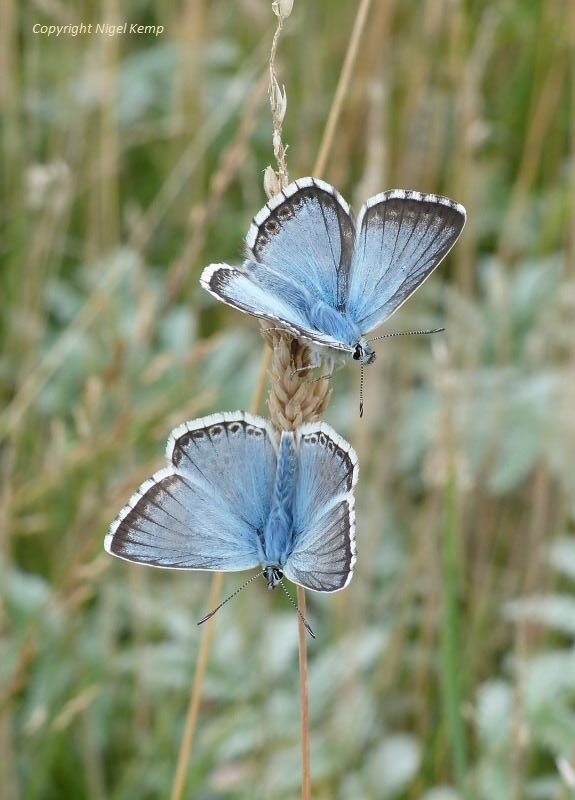
I take many photographs during the course of a season. Trying to see different species of butterfly and dragonfly in their prime during their respective flight seasons can lead to a busy time for the amateur naturalist. Inevitably, some events are quickly overtaken by others and photographs get overlooked. Looking back at this time of year allows me to fill in some gaps.
Visiting Ashdown Forest back in May, I managed to observe a freshly emerging Bird's-nest Orchid (Neottia nidus-avis) over the course of three weeks. This strange orchid contains no chlorophyll and obtains its nutrients from fungi. It is generally found in the shade of long established beech trees.
Bird's-nest Orchid (Neottia nidus-avis)
On 17th May, the flower spike is just starting to emerge.

On 23rd May, one flower is starting to open.

On 2nd June, the plant is nearly in full flower.

The Bee Orchid (Ophrys apifera) has several named varieties, some of which can be quite numerous in some colonies. Var. chlorantha has whitish sepals and a greenish-yellow lip and in some small colonies they can outnumber the typical form. Var. flavescens, which has a pale brown lip, is thought to be a less extreme version of chlorantha.
On the East Sussex Downs back in June, I photographed a Bee Orchid with one flower that I would describe as var. flavescens. I returned to the same plant a week later to find that the original flower was looking more like var. chlorantha. From my own observations, these two varieties appear to be subject to change with age and perhaps all flavescens change to chlorantha over time.
Bee Orchid (Ophrys apifera) (var.flavescens) photographed on 8th June.

The same plant photographed on 15th June. The original (lower) flower is starting to look more like var. chlorantha.

(Reference; "The Orchids of Britain and Ireland" by Anne & Simon Harrap)