Monday, 25 November 2019

Fungi Foray

I have never really taken much of a close interest in Fungi over the years and have only ever been able to positively identify the obvious few.

 Now that the insect world has pretty much bedded down for the winter, I have started to take more notice of the wonderful structures that many fungi are.

 I am never going to be an expert Mycologist but I now find that I want to put names to some of the fungi that I come across. I am more confident at naming some than others and I have quickly realised that just taking photographs in the field and trying to identify them from books at home is fraught with confusion.


Orange Peel Fungus (Aleuria aurantia)


Tawny Grisette (Amanita fulva)


I have been going round in circles trying to name this next species but a bruise test on the pore surface left a brown thumb mark. I think it might be a Penny Bun (Boletus edulis)


Wood Blewit (Lepista nuda)


Yellow Stagshorn (Calocera viscosa)


White Coral Fungus (Clavulina cristata)


Candle-snuff Fungus (Xylaria hypoxylon)


Sunday, 10 November 2019

A Woodland Floor in Autumn

Now that we are into late Autumn, a walk in my local woods has become rather soggy underfoot and the sight and smell of decay is evident through the understorey.

Although there is still a chance of seeing late season insects on any remaining sunny days, new life is emerging through the damp leaf litter of the woodland floor.


Minotaur Beetle (Typhaeus typhoeus) (male) 


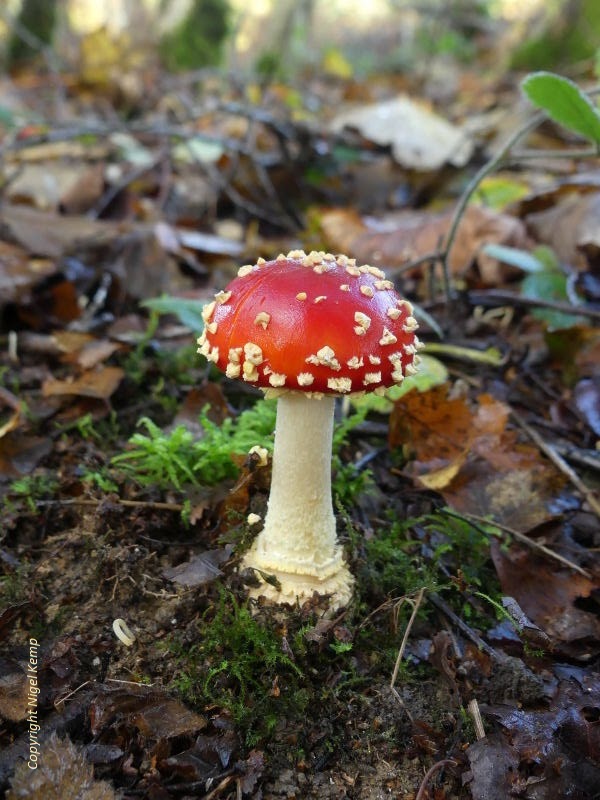
Fly Agaric (Amanita muscaria)

I photographed this specimen on three consecutive days.


The Blusher (Amanita rubescens)


False Death Cap (Amanita citrina)


Stump Puffball (Lycoperdon pyriforme)


Thursday, 17 October 2019

Northern Damselfly and other Scottish Treats

Back in June of this year, we spent a week in Scotland and I had timed our stay to coincide with the flight period of the Northern Damselfly (Coenagrion hastulatum). This is arguably our most endangered species of damselfly in Britain and is confined to just a few sites in and around Abernethy Forest in the Scottish Highlands.

We managed to make use of 45 minutes of sunshine before the weather closed in for the rest of the day. Just a few males were seen.


Northern Damselfly (Coenagrion hastulatum) (males)


The male in the next two photographs was carrying an infestation of mites on the underside of its thorax.


Several species of British butterflies occurring in Scotland have subspecies status. Taxonomy is a very complicated science and I don't pretend to be any sort of expert in this field. In some species, the status is fairly clear-cut but in others there is some disagreement as to whether such status is merited. Suffice to say that Taxonomists are constantly re-evaluating the names of species and subspecies.

For descriptions and current information on this subject, go to the species pages at www.ukbutterflies.co.uk 


Speckled Wood (Pararge aegeria ssp. oblita) (male)

South Shian, Argyllshire.


Green-veined White (Pieris napi ssp. thomsoni) (mating pair, female on right)

Glen Loy, Inverness-shire.


Small Pearl-bordered Fritillary (Boloria selene)

(The Scottish populations of selene were formerly categorised as ssp. insularum but are no longer regarded as being a separate subspecies to the rest of the British populations)  

Glen Loy, Inverness-shire.

males.


females.


Chequered Skipper (Carterocephalus palaemon) (male)

Glen Loy, Inverness-shire.


Argent & Sable (Rheumaptera hastata)

Glen Loy, Inverness-shire.


Clouded Buff (Diacrisia sannio)

 (male aberration, where the normal mustard yellow colour of the forewings has been replaced by pale grey and the pink highlights have been replaced by brown)

Glen Loy, Inverness-shire.


Black Guillemot (Cepphus grylle)

Oban, Argyllshire.


Hooded Crow (Corvus corone cornix) (juvenile)


Northern Marsh Orchid (Dactylorhiza purpurella)


Tuesday, 8 October 2019

Autumn on Pevensey Levels

There is definitely an end-of-season feel in the air as I walk around Pevensey Levels at this time of year. The maize crop has been harvested, the hedges have been cut and the meadows mown.

 Butterfly numbers have fallen away and although I saw my first Clouded Yellow (Colias croceus) of the year (and probably the last) in the last week of September, I have not seen any third brood Wall (Lasiommata megera) this year. 

However, the water ditches are providing plenty of Odonata activity.

The population of Willow Emerald Damselflies (Chalcolestes viridis) that I found in 2018 has grown this year and I have been observing them on a regular basis. Most of the males that I have seen have been holding territories on oak foliage hanging low over the water ditches. I have also seen three pairs in tandem on three different days, all of which were seen flying into the oak foliage. I saw one pair (through binoculars) in ovipositing posture but I cannot be sure that any eggs were laid as the event was brief. The males are now starting to show signs of ageing as they turn from iridescent green to a dull bronze colour.

Migrant Hawkers (Aeshna mixta) are still plentiful and can regularly be found basking together in the autumn sunshine.


Willow Emerald Damselfly (Chalcolestes viridis) (males)


Migrant Hawker (Aeshna mixta) (basking males)


Migrant Hawker (A. mixta) (ovipositing female)


Sunday, 29 September 2019

September Highlights

Between the blustery downpours of late, I have been making use of any quiet weather interludes. Late summer has now turned into autumn and at this time of year I am a regular visitor to my local National Trust gardens to check out any sheltered floral corners for nectaring insects.


Small Copper (Lycaena phlaeas) (female) (ab. extensa) 


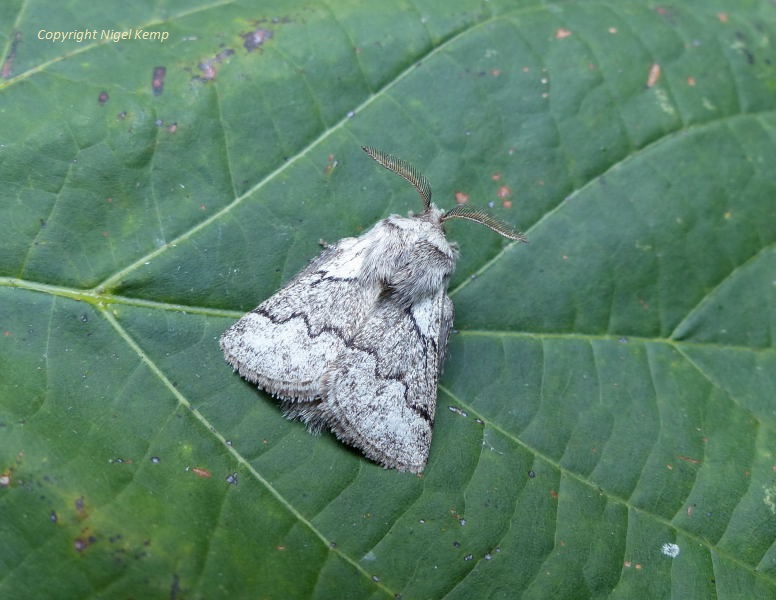
The moth-trap can attract some interesting species during the autumn and a Pale Eggar (Trichiura crataegi) made a first ever appearance to my garden last week


Pale Eggar (Trichiura crataegi) (male)


Autumnal Rustic (Eugnorisma glareosa)


A couple of weeks ago, a friend told me of an interesting caterpillar feeding on purple toadflax in her Eastbourne garden. I photographed it the next day resting on a lavender head and we found another three larvae on other toadflax plants. Nationally, the Toadflax Brocade (Calophasia lunula) is a Red Data Book species but Eastbourne seems to be one of its strongholds.

Toadflax Brocade (Calophasia lunula) (larva)


Whilst the breeding season for most species is coming to an end, autumn marks the start of the mating season for the Purse-web Spider (Atypus affinis) when males can be found above ground searching for female burrows. This species is a distant relative of the Tarantulas, born out by those huge fangs and tail spinnerets. Thankfully, it is only the size of a thumb-nail. 

A few days ago, I was walking with friends along the cliff tops near Seaford in 40mph gusts and heavy showers when I saw this male being blown about across the short grass.


Purse-web Spider (Atypus affinis) (male)