Sunday, 19 August 2018

Southern Emerald Damselfly

Observers of Odonata (Dragonflies and Damselflies) have been experiencing some interesting events in southern England in recent years. A number of species have been moving northwards from the Mediterranean zone over recent decades and have now reached the shores of the English Channel.
 
With regard to Damselflies, two species made the leap across the channel around the turn of the 21st century. The Willow Emerald Damselfly (Lestes (Chalcolestes) viridis) and Small Red-eyed Damselfly (Erythromma viridulum) are now well established as breeding species in south-east England. The Southern Emerald Damselfly (Lestes barbarus) has been turning up in south-east England almost annually in recent years and it is now likely that barbarus will be the next species to establish itself . The Common Winter Damselfly (Sympecma fusca) is another species that may not be far behind. 
 
On 4th August, an observer came across a male barbarus at a dewpond on the East Sussex downs. The next day, my friend Bob Eade went to the site and saw it. I didn't manage to get to the site until ten days later but managed to find and photograph a male. Bob and I are still undecided as to whether our photographs actually depict two different males. I think that images from different cameras and in different light conditions may have confused the issue not to mention a lack of familiarity with this species and how its markings might change as it ages.
 
 
Southern Emerald Damselfly (Lestes barbarus) (male)  


Small Red-eyed Damselfly (Erythromma viridulum) (males)


Sunday, 5 August 2018

Emperor Dragonfly

Earlier this week, whilst walking on Pevensey Levels, I watched a male Emperor Dragonfly (Anax imperator) hawking up and down the edge of a maize field looking for prey. It intercepted a bee and then settled on a maize stem to devour its catch.
 
In the world of insects, the name emperor is usually reserved for those impressive species that turn our heads and grab our attention. Like the Purple Emperor Butterfly (Apatura iris) and the Emperor Moth (Saturnia pavonia), the Emperor Dragonfly is aptly named. It is the largest dragonfly species in Britain and the bright blue abdomen of the male makes it instantly recognisable.
 
 
Emperor Dragonfly (Anax imperator) (male devouring prey) 


Emperor Dragonfly (A.imperator) (ovipositing female)


Fen Raft Spider (Dolomedes plantarius) (female guarding her nursery web)

Thursday, 26 July 2018

Damselfly Encounters

With little shelter from the hot sunshine beating down, I have not ventured onto Pevensey Levels in the last week or so but have sought the shade and coolness of some favourite riverbanks and Wealden ponds in search of damselflies. 
 
The White-legged Damselfly (Platycnemis pennipes) is a localised species in Sussex but often abundant in favoured habitats. Whilst walking along an East Sussex riverbank this week, I disturbed dozens of this attractive and distinctive species.
 
 
White-legged Damselfly (Platycnemis pennipes) (male)


White-legged Damselfly (P.pennipes) (female)


White-legged Damselfly (P.pennipes) (pair in tandem)


Small Red-eyed Damselfly (Erythromma viridulum) (male)
 
This recent colonist from Europe is now a widespread species in south-east England.


Small Red-eyed Damselfly (E.viridulum) (mating)


During Autumn 2017, I found dozens of egg sacs of the Wasp Spider (Argiope bruennichi) in a Wealden woodland clearing. I returned to the site last week to look for adult females on their webs. These striking spiders make a distinctive web with zig-zag 'sutures' within the structure.
 
 
Wasp Spider (Argiope bruennichi) (female)


A couple of favourites from the moth-trap this week.
 
 
Iron Prominent (Notodonta dromedarius)
 
This open winged view shows the tufts on the trailing edge of the forewings that give the Prominent family their name.


Scalloped Oak (Crocallis elinguaria)


Sunday, 15 July 2018

The Wood White and a Prickly Garden Visitor

On 4th July I was keen to connect with the Purple Emperor (Apatura iris) in the woods of the West Sussex/Surrey borders. We were off on holiday to Cumbria the following week and it was probably going to be my only chance to see this lovely insect this year.
 
However, I wasn't expecting to see second brood Wood White (Leptidea sinapis) on the wing quite so early in the month. This delicate member of the Pieridae family tends to flutter endlessly along the ride edges, just a couple of feet from the ground and seemingly never pausing for rest.
 
 
Wood White (Leptidea sinapis) (female)


Courtship in the Wood White is fascinating to watch. The male (right) sits head to head with the female and flicks his wings whilst caressing her with his antennae and proboscis. I have often seen this behaviour over the years but have yet to see it result in mating.


Wood White (L.sinapis) (male)


Purple Emperor (Apatura iris) (male)
 
Even a rather washed out male is a beauty to behold.


Silver-washed Fritillary (Argynnis paphia) (male)
 
I took this photograph a couple of weeks earlier in an East Sussex wood.


The evening before my day with sinapis and iris, I was called out into the back garden where Carol had found a sub-adult Hedgehog (Erinaceus europaeus) snuffling about on the lawn.
 
Last year, they nested underneath a hedge beside our garage and it was nice to see that they are probably doing so again this year.
 
At mid-morning, a couple of days later, Carol came across an adult in the back garden.
 
 
Hedgehog (Erinaceus europaeus) (sub-adult)


Hedgehog (E.europaeus) (adult)


Monday, 25 June 2018

The Beauty of Moths

If you think that moths are boring little brown things that eat clothes and blunder around your front room light in the evenings then think again.
 
About 2,500 species of moths occur in Britain and only about half a dozen of those can be described as clothes moths; mainly small moths from the family Tineidae.
 
Many of our native species are beautiful creatures and are deserving of close attention.
 
Here are a few that have been attracted to the garden moth trap over the last few weeks.
 
 
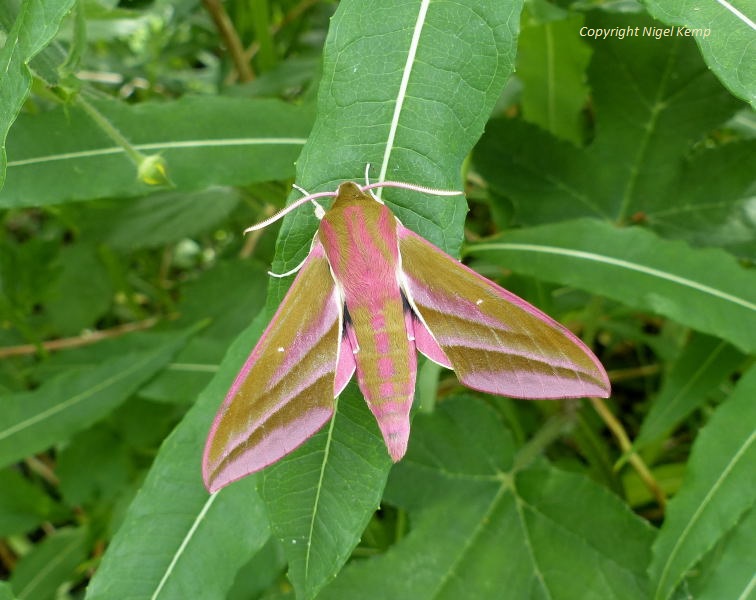
Elephant Hawkmoth (Deilephila elpenor)


Eyed Hawkmoth (Smerinthus ocellata)


Scarce Silver-lines (Bena bicolorana)


Alder Kitten (Furcula bicuspis)


Dot Moth (Melanchra persicariae)


Grey Dagger (Acronicta psi)
This species is virtually impossible to tell apart from the Dark Dagger (A.tridens) in the adult stage but I am pretty certain that this is psi on the grounds that I have only ever found the larvae of this species in my garden, which are very different from the larvae of tridens.


A walk in a Wealden wood on a warm dull day can be a good time to find moths sitting out in the open rather than hiding away from the sunshine.
 
 
Birch Mocha (Cyclophora albipunctata


Nemophora degeerella (male)
The male of this Longhorn species has ridiculously long antennae.


Yellow Shell (Camptogramma bilineata)


Thursday, 14 June 2018

Norfolk Hawker Dragonfly

We have just returned from a few days away with friends on the Suffolk coast. Soon after our arrival, I was out on the marshes looking for wildlife in general and the rare Norfolk Hawker (Aeshna isosceles) in particular. This dragonfly has traditionally been restricted to the Norfolk Broads but in recent years it has been appearing along the Suffolk coastal marshes and also in North Kent.

Whether the species has expanded its range out of Norfolk or whether populations have been established by migrants from Europe is unclear. I suspect the latter but either way it is good to see this lovely species of dragonfly expanding its range in England.


Norfolk Hawker (Aeshna isosceles) (males)


Golden-bloomed Grey Longhorn Beetle (Agapanthia villosoviridescens)


Red Deer (Cervus elaphus) (female)


Southern Marsh Orchid (Dactylorhiza praetermissa)


The Saxon burial grounds at Sutton Hoo in Suffolk have long been on my 'must visit' list. This is a significant historical site where, in 1939, a local archaeologist, Basil Brown, discovered a Saxon ship burial. In fact, two ship burials were uncovered on the site. These and only one other, at nearby Snape, have ever been discovered in Britain.


The famous 'Mound 1' where the intact ship burial containing the Sutton Hoo helmet was discovered.