Sunday, 14 January 2018

From the Cutting Room Floor

Every year, as the new season gets underway, insect activity moves on apace and the life of the amateur naturalist can become very busy. I take many more photographs than ever appear on my blog posts and the winter months offer a good opportunity for me to look back at some of the images that missed the final cut.
 
 
Dark Crimson Underwing (Catocala sponsa)
 
Back in May 2017, Carol and I were walking in a mature mixed woodland in West Sussex when I spotted a large moth larva at rest on a stem of pendulous sedge. I could hazard a guess as to the family of moths to which it belonged but I didn't arrive at a proper identification until I got home and consulted my books. I was pretty certain that I had found the mature larva of a Dark Crimson Underwing (C.sponsa), a red data species that is now restricted to the New Forest as a breeding species in the UK. Singletons (generally regarded as migrants) are occasionally attracted to moth traps in Sussex but this is the first record of a larva found in the wild in the county since 1857.
 
(Reference; "A Complete History of the Butterflies and Moths of Sussex" vol. 3, by Colin R. Pratt)


Spiked Rampion (Phyteuma spicatum)
 
Also during May 2017, Bob and I decided to seek out the rare and endangered Spiked Rampion (P.spicatum) which only survives in the UK at just a few sites in East Sussex. It turned out that one of the sites is only about three miles from where I live.


Ctenophora flaveolata (Cranefly sp.)
 
In May 2017, as in most years, Bob and I headed off to the ancient woodlands of Kent to connect with the Duke of Burgundy (butterfly) but these woods are also rich in other rare insects as well as wild orchids. On this occasion we happened upon an impressive and rare species of Cranefly  (Ctenophora flaveolata) that can only be found in a few scattered ancient woodland sites in southern England. I shall certainly be on the lookout for it in 2018 and to try and get some better photographs.


Fen Raft Spider (Dolomedes plantarius)
 
In June 2017, on Pevensey Levels, I took this photograph of a female Fen Raft Spider (D.plantarius) tending her egg sac. It wasn't until I got home later in the day that I noticed that her second leg was deformed, possibly caused during a skin-shed.


Ringlet (Aphantopus hyperantus) (female, ab.arete) 
 
In July 2017, whilst on holiday in Cumbria, I photographed this ab. arete, (where the normal ringlet eyespots are reduced to white dots). I have always found arete hard to come by in the woods of East Sussex but in this particular Cumbrian colony I found that up to 5% of the population were so affected. 


Brimstone (Gonepteryx rhamni) (male)
 
In August 2017, I came across this Brimstone (G.rhamni) oddity in one of my local woods. The strange markings are pathological in origin and are caused by leakage from damaged veins into the wing membrane. I have included a photograph of a normally marked male for comparison. 


Friday, 22 December 2017

Masters of Disguise

Butterflies and moths are near the bottom of the food chain and they have many predators. Different species adopt numerous strategies to protect themselves from being eaten. Some species are extremely distasteful to predators and advertise the fact by displaying warning colours that are generally recognised by predators. Other species use startle tactics, suddenly displaying eyespots and other markings designed to confuse a predator long enough for the target to make its escape.
 
Butterflies and moths are probably most vulnerable when they are at rest or during their immature stages and in the vast majority of cases, cryptic markings are used to make them blend into the background. Again, different strategies are adopted, ranging from straight-forward camouflage markings to mimicking broken twigs or bird droppings. 
 
Nearly all butterflies roost with their wings closed and it is usually their underwings that are cryptically marked. On the other hand, moths nearly always roost with wings spread and the upperside of their wings are often unobtrusively marked.


The Grayling (Hipparchia semele)
This butterfly virtually disappears into the background when at rest. If it feels threatened it will usually flash its eyespots before then taking off. The first photograph shows a female and the next two are of a male.


The Chinese Character (Cilix glaucata)
This species of moth is a classic bird dropping mimic.


The following photographs are of several Geometrid moths that are among many species that use their markings to blend into the background.
 
 
Red-green Carpet (Chloroclysta siterata)


Green Pug (Pasiphila rectangulata)


Double-striped Pug (Gymnoscelis rufifasciata)


Pale Brindled Beauty (Phigalia pilosaria)


Waved Umber (Menophra abruptaria)


Engrailed (Ectropis bistortata)


Grey Birch (Aethalura punctulata)


Even larger species such as the hawkmoths can be easily overlooked from just a short distance away.
 
 
Lime Hawkmoth (Mimas tiliae)


Eyed Hawkmoth (Smerinthus ocellata)
The diagonal body stripes make sense when you see the larva resting on the foodplant.


Lobster Moth (Stauropus fagi)


Buff-tip (Phalera bucephala)
This species is a broken twig mimic and bears an uncanny resemblance to a piece of birch.


Pale Prominent (Pterostoma palpina)
Another stick mimic.


Pale Pinion (Lithophane hepatica)
A stick or bud mimic.


Merveille du Jour (Dichonia aprilina)


Red Underwing (Catocala nupta)


Saturday, 25 November 2017

Life Cycle of the White Admiral

Now that autumn is moving towards winter, much of my time will be spent working in the wood. Rhododendron and bracken control is always on the agenda but coppicing, ride widening and wood thinning are essential in order to maximise potential breeding habitat for butterflies and moths.
 
Historically, most of our (now rare) woodland fritillary species would have been common in our wood. However, species such as the Pearl-bordered (Boloria euphrosyne), Small Pearl-bordered (Boloria selene) and Heath (Melitaea athalia) Fritillaries are highly unlikely to return naturally. I therefore focus my efforts on keeping the habitat right for species like the White Admiral (Limenitis camilla), which breeds in the wood in small numbers and also to encourage the Silver-washed Fritillary (Argynnis paphia) to increase its tiny population.
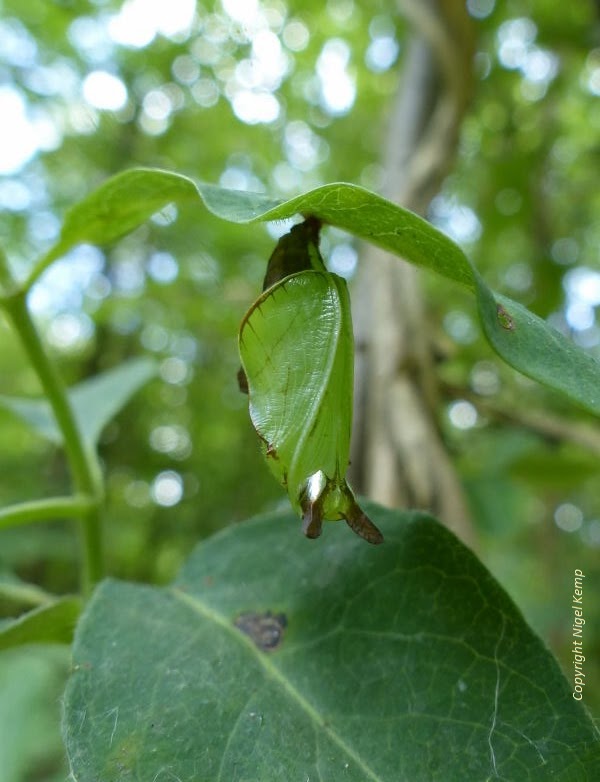
 
 
Life Cycle of the White Admiral (Limenitis camilla)
 
During the winter months, the White Admiral (L.camilla) hibernates as a tiny larva. It emerges from its hibernaculum in early spring and is fully grown by the end of May or early June. The pupa stage lasts for 2-3 weeks and the adult butterflies are usually on the wing from mid-June until the end of August. The ova are laid on honeysuckle leaves and the next generation of young larvae will start to build a new hibernaculum for the coming winter. 
 
 
A third instar larva remains close to its hibernaculum and a recently shed skin can be seen just above and behind the larva. (20th April 2015)


A fourth instar larva on honeysuckle. (28th April 2017)


A fifth instar larva on a honeysuckle stem. (21st May 2017)


The same larva is suspended from a stem node of honeysuckle about 15 feet from the ground and in 90% shade. (27th May 2017)


Two hours later and the larva has shed its final skin. The pupal membrane is yet to harden.
 (27th May 2017)


The same pupa (dark form).  (29th May 2017)


The same pupa (dark form). The pupa in this species has evolved to look like a crumpled honeysuckle leaf. The shadowy markings and reflective mirrors are clearly designed to break up its outline and make it less visible to predators. (4th June 2017)


Another final instar larva prepares to pupate beneath a honeysuckle leaf about 7 feet from the ground.
(31st May 2017)


The next day, the same larva has pupated. (1st June 2017)


The same pupa has adopted the more usual colour form. (2nd June 2017)


The same pupa. (4th June 2017)


The same pupa. (9th June 2017)


Sadly, the same pupa has been predated upon by a bird. Only the cremaster remains attached to the underside of the leaf. (11th June 2017)


The following three photographs are of a male White Admiral, freshly emerged from the dark form pupa. The left antenna is missing its tip and its left foreleg appears to be paralysed. After it had hardened its wings, I watched it fly up into the woodland canopy. (14th June 2017) 


The recovered pupa case shows that the pupa has sustained an injury or damage during its development. This has clearly interfered with the formation of the left antenna and is probably the cause of the paralysis in the left foreleg. (15th June 2017) 


My camera is not ideal for taking photographs of a pin-head sized ovum in subdued light but this image shows that the ovum is typically laid on the upper edge of a honeysuckle leaf.
(8th August 2017) 


The following photographs are of a second instar larva constructing its hibernaculum in preparation for the coming winter. The larva was about 6mm in length. (8th August 2017)